It’s a little known condition that affects millions of people each year. Sadly, as yet, there’s no cure.
Patients with ExpatriaDéjà Vu generally have to manage their own symptoms through rest, silence and keeping up fluids. Unlike other conditions in the Expatria family, the consumption of a small amount of alcohol reduces some symptoms, but you are still advised not to operate machinery.
‘Holidays at Home’ (50mg tablets) is currently one of two products on the market designed to help people recuperate temporarily. You are advised, however, to use ‘Holidays at Home’ with caution as this medication is also known to increase the severity of symptoms of Expatria Déjà Vu.
Expatria Déjà Vu and ‘Holidays at Home’
Read this article carefully before you start taking ‘Holidays at Home’ tablets, because it contains important information for you.
Keep this information. You may need to read it again once ‘home’ If you have any further questions, ask a doctor (expat friend) for advice If you get any side effects, talk to your tribe soon.
What is included in this information?
* What ‘Holidays at Home’ is used for * What you need to know before you take ‘Holidays at Home’ tablets * How to take ‘Holidays at Home’ * Possible side effects * How to store ‘Holidays at Home’ * Additional information
1.What ‘Holidays at Home’ is used for
Holidays at Home contains the active substance, ‘repetitious conversation’. Holidays at Home is one of a group of Expatria medicines called, Hell for Expats in Leisure Periods – Mental Exhaustion (HELP-MEs); these medicines are used to treat Repetitive Conversation disorders.
‘Holidays at Home’ can be used to treat: *Expatria Déjà Vu, the common condition experienced by expats when they go home for holidays (in adults and children).
Expatria Déjà Vu is a circumstancial condition with symptoms like: * feeling frustrated * memory loss – especially being unable to remember if you’ve already said the words you’re about to say * confusion – primarily about why people think you need to come home to live * misunderstandings when you try to dispell myth and clichés about your host country * Mental fatigue * Loss of interest in conversations
Your family has decided that this medicine is suitable for treating your condition. You should however, consult your doctor (expat friends) if you are unsure why you are taking ‘Holidays at Home’.
If you are concerned about whether you have the condition, the image below shows you what Expatria Déjà Vu looks like under the microscope.
What Expatria Déjà Vu looks like under the microscope
2.What you need to know before you take ‘Holidays at Home’
DO NOT TAKE ‘Holidays at Home’:
* If you are allergic to ‘Holidays at Home’ or any other ingredients of this medicine * If you are taking or have taken medicines called Family Fight, Overbearing Sister or Any Friend that Suggests it’s Time to Come Back * If your last four ‘holidays’ have been at home not the tropical island you want to visit.
TALK TO YOUR DOCTOR (expat friends) if you are taking the following medicines:
* Remind Me Why I’m Going Home * Got Any Tips for Answering Repetitive Questions? * How Long Do You Think I Can Survive?
3. How to take ‘Holidays at Home’
Always take this medicine exactly as prescribed. The recommended dose for adults is One Week Staying in a Nearby Hotel with your Own Leisure Activities Every Second Day. If Expatria Déjà Vu symptoms do not ease after 1 week, dosage can be increased to Create a Mailing List to Regularly Update Your People. This will help ease the repetitive questions in time.
4. Possible side effects
Like all medicines, ‘Holidays at Home’ can cause side effects, although not everyone gets them. When treating Expatria Déjà Vu, the most common side effect of ‘Holidays at Home’ is Minor Frustration which often dissipates with sleep, a small amount of alcohol and continued treatment.
Talk to yourself and moderate your behaviour immediately if you experience any of the following:
* Aggressive behaviour towards your loved ones * Name calling, rudeness or angry tone of voice * Disinterest in having the conversation. They care. * Frustration at their ignorance. Why would they know any different if they haven’t visited?
COMMON (may affect 1 in 10 people)
* Minor Frustration * Fatigue * Memory Loss * Confusion * A sense of déjà vu
UNCOMMON (may affect 1 in 100 people)
* Sarcastic comments * Change subject entirely which confuses loved ones * You ask all the questions to avoid talking about your life * Do not see family and friends when at home.
RARE (may affect 1 in 1000 people)
* Return from holiday early * Cease friendships
5.How to store ‘Holidays at Home’
Do not use this medicine after the expiry date.
Store in ambiant conditions with: * Grace * Kindness * An open heart * Patience * Love * Tolerance
If symptoms persist, consult your doctor (expat friends).
Just over a year ago I wrote about my father’s death from a few months earlier.
I’d wanted to write about it for a while, but kept running, not knowing what to say.
Why is my loss any greater than anyone else’s?
Writing publicly felt indulgent. Look at me, poor me, my father has died. Give me sympathy etc.
It felt reminiscent of the Facebook Martyrs who post ‘Oh, some people!” as an invitation for support from their ‘friends’. They then wait for the sychopantic dopamine hit that comes with the replies.
But on this day it felt right. It was right. I wrote it in 20 mins – far shorter than the usual 2 hours I allow.
Essentially, I just closed my eyes and wrote from my heart. My thoughts seemed to flow in a way that hadn’t been present before.
The difference? I was being authentic. I was being real. I wasn’t hiding.
I was honoring him and digging deep. In visiting that place that hurts, I’d also opened up the vessel to healing.
Navigating Hurting and Healing
When we run away from the difficult stuff, we can never run fast enough. Actually, I think it’s a way better athlete than us. It’s exceptionally good at running – always a few paces ahead, ready to anticipate our thoughts and block us from smashing through the ribbon on the finish line.
But did you know that Loss and its cousins, Pain and Fear are shapeshifters?
When they are not running with us, they take on the form of that blasted and increadibly annoying mosquito, buzzing in the room at night. It never leaves you, but it doesn’t bite you either.
It hovers, just enough to agitate and keep you from peaceful rest.
Writing my blog that day gave me rest. It’s why I draw the illustrations I do. They too give me rest from those pesky shapeshifters.
Why We Need to Create Emotional Rest
Loss is loss is loss is loss is loss is loss is loss is loss is loss…… (Get the picture?)
Whether your sense of loss comes from a death, a serious injury in which you need time off work, or as a rotational expat saying goodbye to friends every two years, it has an impact.
Furthermore, the trauma stays in the body until it is dealt with. Even before we have words, trauma leaves its imprint on our physical body. It lies there, not particularly dormant until it is processed – and can lead to complex illness and health problems. For example, we know Post Traumatic Stress Disorder (PTSD) causes visible changes to the brain, demonstrated too by Ariana Grande after the terrorist attack on her Manchester concert.
10 Ways To Help Navigate the ‘Difficult Stuff’
Firstly, let me say, I am no doctor. I am not trained in mental health, nor am I trauma specialist. I am also NOT offering these 10 tips as medical advice or in anyway suggesting that they replace seeking proper medical help.
This list is purely based on my own experience and the things that have helped me in the past.
ONE: Write down your thoughts During a family trauma of mine, I used to lie in bed for hours at night – wide awake; my brain not able to switch off. Eventually, I learnt to get up, write it all down and then I would go straight to sleep. Try it.
TWO: Wait until the morning to make decisions Night time is a strange liminal space. In those years of family trauma, I came up with some of my best ideas and solutions in the middle of the night. That was, until the morning, when the cold light of day exposed their ridiculous truth. Sleep fixed these irrational thoughts and perceptions and I was so pleased I hadn’t acted upon them in the night.
THREE: Seek spiritual support Before I came to the UK, I had no time for spirituality or religion. I wasn’t just not interested, I actively disliked it. No longer able to ignore the things I was experiencing, I now work as a Shamanic Practitioner. 🙂 It’s all just energy – a life force which goes by many names. It’s that gut reaction to the person we want to keep as arm’s length. It’s our Intuition. It’s God, Allah, El Shaddai, Ik Onkar, Great Spirit to name a few. Shamanic practitioners offer alternative techniques and practices which personally, I have found especially helpful for removing blockages. Email Cath for a confidential chat.
FOUR: Make memories permanent Memory or Keepsake Boxes store mementos, stories, photos and other objects. They are designed to commemorate special people or events in your life. Creating a memory box as a family can help children (particularly cross cultural and third culture kids) to process the regularity of transition including the friends they’ve had to say goodbye to. Equally, if a parent or sibling is terminally ill, creating the box together whilst they are alive helps the family prepare.
FIVE: Commission an illustration If you’re missing a loved one who lives elsewhere or you’re anticipating the loss of a friend who’s about to move away, a bespoke illustration can show them how much you love them and miss them. Illustrations creates a permanent celebration of the times you’ve shared and as a keepsake, helps you feel connected from afar. Email Cath if you’d like to order one for family and friends.
SIX: Take up exercise I’ve become a runner. I can’t quite believe it, but I love it. We’re not all Usain Bolt, but the effect of the exercise is the same. Whether you enjoy a walk or a 5km run, exercise improves mental health and comes with a lot of other benefits. For me it sorts out my emotions, relieves stress, separates work and homelife (I work in a home office), keeps my mental health in check and gives me thinking time. It’s everything to me.
SEVEN: Make a regular coffee date The old adage, a problem shared is a problem halved is one of my favourites. Talking gives the same benefit as writing something down. You get it off your chest/out of your head. Meeting a trusted friend regularly for a coffee can reduce the intensity of what you’re dealing with. Human connection nourishes our souls. A trusted friend will also offer other perspectives and will not be afraid to be honest and love you when you are finding it hard to love yourself.
EIGHT: Find the Opportunity I firmly believe that there is a benefit to every situation, even in the most difficult ones. It’s when we feel most uncomfortable that we experience our biggest growth. I have had times in my life which I never want to repeat, but for which I am equally grateful. These are the times I have learnt the most about myself. I know it’s hard but what is the opportunity within your struggle? What are you learning?
NINE: Buy a mosquito swot to smack it I say this in jest, but also in seriousness. Sometimes all we want is to ignore the problem and for it to go away. And that’s okay. When we’re stressed, our coping strategies are pushed to their limits, but part of coping is self-care. We don’t need to be strong, to fight a brave battle, or whatever other phrases people offer. Sometimes all we need is take off some pressure and look after ourselves. There’s always another day.
TEN: Seek medical help Yes, there is always another day…. but if you realise that ‘another day’ is becoming every day and you’re aware you’re struggling more than usual, please seek medical help. When I couldn’t get off the sofa to make a coffee without having a panic attack and had no clue how to find myself again in the heavy cloud, I knew it was time to see the doctor. I am forever thankful that I did.
You know those people who have perfectly ordered drawers? Don’t worry. I dislike them also.
I have to be honest though. I think I’ve always been a little bit jealous. Again, don’t worry. I know you understand.
A few months ago, I decided to become one of those people. I’m a little nervous now. Are we still friends?
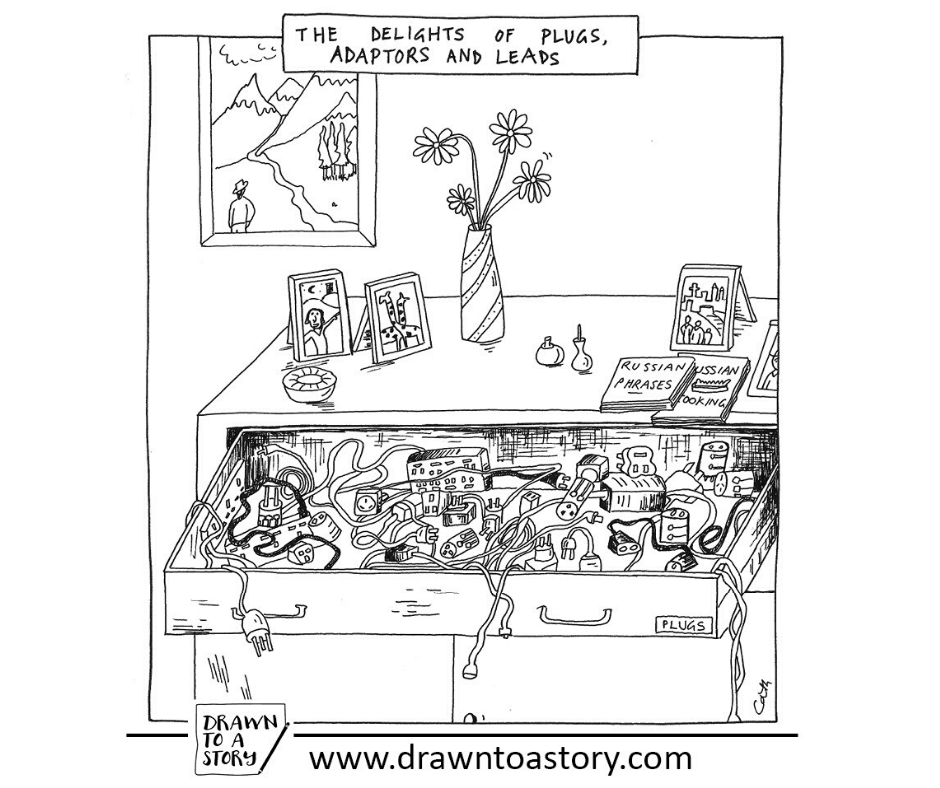
It’s okay. I’ve still got the ubiqutious ‘junk drawer’; it just now resembles a drawer belonging to the Ordered Drawer Brigade. I cleaned it up. I had to.
It resembled my cartoon below.
I’m guessing that if you’re an expat, you’ll also recognise the drawer of travel adaptors, plugs, cables.
When I’m unable to travel, they’re my lifeline to the outside world – a comfort blanket with the following words sewn in: Travel is always possible if you have the adptors, plugs and cables.
I’m reminded of a massive safety pin/nappy pin. The cheeky side of me wants to say, ‘It all goes to shit if you don’t use one’, but I’m not that rude.
But the adaptor and plugs ARE like the safety pin that I use to store my other safety pins.
They all fit together, but it’s not quite how you’re meant to use them.
The travel adaptor drawer is the same.
Numerous plugs and cables looking like they all go together, but each having a very particular purpose that is only effective when fitted correctly.
But all is not lost.
Stillness and Order
I think the travel adaptor/plug/cable drawer allows us to create order in our life.
In the chaos of the mess, a stillness arrives. Each travel adaptor releases a memory of a holiday to another country or the 2 years you lived elsewhere. I even remember hotel rooms in which they featured or cafes I’ve worked in and had to rush back to to collect the plug I accidentally left in the wall.
Each of these plugs and adaptors act as a key to unlock my memories. Memories that connect me to my soul food: Travel and Connection.
Soul Food: Travel and Connection
It may sound unusual to read so much into the travel adaptor drawer, but I find objects especially powerful for deciphering the intangible – That stuff we know in our gut but can’t quite verbalise. It’s hidden, it’s within us and it’s where we make meaning.
So it seems that the humble travel adaptor is quite powerful after all. Even when it’s been used within an inch of its life and we think it’s not connecting to the power source, it works mighty fine. Have you considered connecting it to its other power source?
YOU.
Yes, by all means buy another adaptor to operate your iPad, but use the other one as a key. Turn the lock and revisit your memories. You might find that the crappy adaptor that barely ever worked, now makes you envious of the time you shared.
Simultaneously, her wife thinks, What have I agreed to?
Neither says a word. That is, until….a man walks towards them, beaming with a big smile. Welcome to Taiwan. I’m Pin-Jui from the company. Let me take your bags and settle you in to your new home.
They reply: Fantastic Thank you. I can’t wait! Me neither, I’m so pleased to be here.
Sound familiar? Expatriate postings are like those extreme sport team-building days. There’s tension in the air, but you’re not quite sure if the adrenalin is exciting or terrifying.
My good friend Sundae Bean, says that as globally mobile people, we live ‘Olympic Level Lives’. Believe me, she knows her stuff. She’s an intercultural strategist and solution-oriented coach who also lives this life.
She right. This life kind of takes you apart, then puts you all back together again, many times over. And that’s now in 2020 when we are at a all time high for ease of instant communication. What about 10 years ago? 20 years ago? Or even more than 50 years ago?
It’s almost unfathomable to me. Imagine setting off in the 1920s unsure of where you’d end up and when – or if – you’d ever see your family again.
This first illustration from my book, ‘Living Elsewhere’ sets out some timely perspectives.
So what’s it been like through the Years? There’s nothing better than words from the people themselves. For this, I have turned to my trusty resource, ‘The Source Book’, which I bought from the Expatriate Archive Centre in The Hague in 2018. This wonderful centre describes itself as a home for expat life stories.
So with my copy of The Source Book at hand, let me introduce you to our community of life-builders, the heroes, the brave, the determined, the emotionally resilient, the fiesty, the inventive, the survivors, the thrivers, the problem solvers and the inordinately adaptive people we call expats.
As you read on, I invite you to think about the skills developed, the lessons learned and the life review that these remarkable experiences trigger.
Take a moment too to reflect on each ‘PAUSE FOR THOUGHT’.
1920s
Malaysia in the 1920s
The day for my departure came so, in 1926, with my two small daughters. I embarked on the P&O liner ‘Morea’ at the start of a six week journey to a place called Lutong, Miri, Sarawak. At last after four weeks we reached Singapore…and were met by my husband… After nearly a week sailing over the China Sea we arrived off the coast of Sarawak….
On our arrival at the Lutong wharf we were met by the company men, Chinese coolies[sic], with four wheeled trolleys. Sitting back to back we were pushed through the jungle along a rentus (track) for two miles… our luggage on a following trolley, and so we arrived at the bungalow that was to be our home for six years. – JG about EM, Malaysia, 1926 [The Source Book, page 035, EAC Ref 0500/479]
PAUSE FOR THOUGHT: How would a long journey like this help alleviate arrival culture shock and subsequent transition?
1960s
Husband in Prison
My husband was one of the many rounded up and put in Seria Police station. The rebels took possession of all the cars. One night…some of the hostages were taken in a truck to part of the road near Panaga Police station. They were lined across it and used as a shield and were caught in the crossfire between Police and the Rebels. One man was killed and several others were badly injured. Lachie had been a POW for five years during the war and there was no way he was going to be locked up again. He escaped across a bit of jungle. – EM, Seria, Brunei, 1960s [The Source Book, page 75, EAC Ref oacl/33/4/1]
Civilities in the Aftermath of Civil War
I heard the door being kicked heavily, and, as I turned to see what was happending, a soldier, gun pointing towards me, propelled himself through the new open door…. Unable to speak I simply raised my eyebrows – “I want your school closed down now” he demanded. “All right” I finally managed to quake, no problem at all – can we discuss this?”
As the gun began to drop slightly lower and away from his face, I realised he was looking as frightened and unsure as I felt. Throwing caution to the winds, I asked him in what Province he had been at school… The gun lowered, he relaxed and we leafed together through one of the standard English texts in use in most primary schools. He had wanted to continue his education, but the army provided a surer living…. He finally confessed that what he had come for was to ask me to provide…some space for use as a polling station. Together, we toured the compound and decided that one classroom nearest the entrance would be quite sufficient…. As we parted he almost shoook my hand – but his gun got in the way. – AR, Nigeria, 1960 [The Source Book, page 119-120, EAC Ref 0401/54]
PAUSE FOR THOUGHT: Have you and/or your spouse worked out what are your non-negotiables? What scenarios have to happen for you to leave the country? Natural disasters? Civil unrest? Threat and experience of violence? The currency become vastly inflated?
1970s
Tanker Hit by a Missile I was taken to the Graille Hospital in Saigon and eventually operated on to take the shrapnel, glass shards and burnt wire strands from my many wounds I had to my side, shoulders, head and neck, and then was stitched up well vaccinated with a syringe the size of a stirrup pump. The French surgeon wore shorts, a flowery shirt and flip-flops on this feet, with a Gauloise cigarette haning from the lips, ‘picture the scene’…. and asked Carol to come and watch while he operated, no anaesthetic, of course…. just like out of war movie, only this was for real. – CM, Vietnam, 1972 [The Source Book, page 98, EAC Ref 0905/763]
PAUSE FOR THOUGHT: What has using local medical services made you grateful for? How do you actively apply that gratitude in your life?
1980s
First Week in Bangkok In our first week I was browsing through an antique shop and asked the owner to recommend a good rug dealer. He stared blankly, so I squatted to show him the floor. “Ah Toilet!” he said delightedly and ushered me to the back of the shop. – CC, Bangkok, Thailand 1984 [The Source Book, page 41, EAC Ref 0600/166]
Hidden Talents Women may not drive, cycle or employ female domestic help. Some feel they are living in ‘gilded cages’…. Homesickness can be a real problem especially as extended family members may not visit and living in such a restrictive atmosphere can lead to paranoia and depression in various degrees.
Officially we’re not allowed to gather in groups and certainly not mixed (male and female). We are extremely fortunate however, in having a great GM’s wife who pointed out that we all have talents which we should use…I have just set up a small mixed choir (no previous experience in conducting!) and we plan to have a house concert very soon: prohibited of course and we have to leave out potentially provocative words. – PH, Saudi, 1984 [The Source Book, page 57, EAC Ref 0007/732]
PAUSE FOR THOUGHT: In what ways can you ‘get creative’ and use your talents to create great connections and purpose in your life?
1990s
Prohibited Equipment When our seafreight arrived in Nigeria, we were informed that the agent had been thrown into prison because customs had found consignment of military uniforms in our possession. What?! In fact my husband had an old pair of camouflage trousers he used to wear when photographing in the Gabonese jungle…. He was summonsed before the General at the military base to apologise. [Shell paid a large sum and the agent was freed]
… A similar thing happened to friends of ours a couple of years later. They were accused of importing ‘espionage equipment’. This was in fact a small canoe acquired for their children. – KM, Nigeria, 1997 [The Source Book, page 70, EAC Ref oac5/1/1/12]
A Guide to Etiquette in Delhi The plumber – sadly everything leaks but he will persist in his repairs and come immediately. Sadly he fails to understand why we want the luxury of water out of both taps. – SP, India, 1995
PAUSE FOR THOUGHT: The best cultural interactions occur when both parties feel ‘met’. How do you deal with challenges within another culture? Do you only see it your way, or are you able to stop and meet them in the middle? If your way is not working, perhaps try another option and open yourself to their cultural approach. What have you got to lose?
2000s
Bacon and Eggs We knew we were moving because mum offered us bacon and eggs for breakfast – GL reporting words of her son CL: Den Haag, 2005 [The Source Book, page 122, EAC Ref oac5/6/2/7]
Relocating with Special Needs Children When a family of a child with special needs learns of a possible international relocation, the rug literally is pulled out from under them. Even when research and treatment may be more advanced in the new country, parents need to learn an entirely different system, understahd the cultural context of special needs, and rethink best practice when considerable time, energy, thought and effort already have gone into the project. There may be insurance issues to be explored or mastered. – LP, London, UK, 2004 [The Source Book, page 103, EAC Ref 0100/4/3/2]
Boarding School I don’t know anyone who sent their children to boarding school because they wanted to. – AM, Den Haag, 2005 [The Source Book, page 123, EAC Ref oac5/6/2/22]
New Habits My husband never drank alcohol until we went to Nigeria. – KM, The Hague, Netherlands, 2006 [The Source Book, page 101, EAC Ref oac5/6/5/7]
PAUSE FOR THOUGHT: How we behave off the situations that present themselves to us can dramatically influence our mental and physcial health This includes what we’re like to live with and work with too. How can you transform your choices that you choose through gritted teeth into ones taht you welcome openly, warmly and with purpose?
I hope that you can grace me a minute to remind you of the words I used at the beginning to describe expats: Life-builders, the heroes, the brave, the determined,the emotionally resilient, the fiesty, the inventive, the survivors, the thrivers, the problem solvers and inordinately adaptive.
I don’t see how we can see them as anything else. Do you? They’ve worn their shoes well. So well, they might need to retire them, but that’s another blog for another day.
Cath x
“No matter what the situation, remind yourself, I have a choice”
For people who live a global life with work postings in different countries that last a few years, a one way ticket can be exciting. It’s time for a new adventure and a chance to explore a new place. Whilst there’s stress in organising another move, you know it’s not forever.
So what about when it could be forever?
In early March at the Families in Global Transition conference, I heard the expression ‘lovepat’ for the first time. I’ve never really felt comfortable using the term ‘expat’, one of the main reasons being, that it feels like a temporary move for work. I’m not in England temporarily, or at least I can’t think that way as otherwise I would never settle.
I’ve been here over 11 years now. Am I still am expat? I don’t have a contract that I know will end in 2-3 years and then I’ll go home. I moved for love. My wife is British and I moved to England to live with her. So….lovepat it is.
So how does a one way ticket feel for a lovepat?
It’s quite something to sit on a plane, having packed up your entire life and know that you’re leaving home, but not know if you will ever return. I felt excited and enjoyed the feeling of the unknown, but I was also a bit scared and slightly unsure – was I doing the right thing? But deep down I knew that I still had choices to return home to live if I wanted to.
It’s a powerful statement isn’t it? ‘Exile is a kind of death, but I try to live.’
Imagine living with that everyday. Imagine our friends in Syria who cannot go home as home no longer exists. Imagine the exiled LGBTQI person that will be murdered if they go home. Imagine knowing that you will never go home to all the people and places you hold dear.
It’s beyond painful…. But exile is not just about people from other countries. Imagine feeling like you’re in exile because no one understands you and your autism. Imagine the stress of trying to do your job well, but your dyspraxia plays havic with your ability to remember what your boss asked you to do. Imagine people always looking at you oddly because your muscles make you walk differently.
We need to care and support people. We need to ask them what they need, because until we’ve walked in their shoes we know nothing of their lives.
But we can listen. We can listen openly and with love, and we can see ourselves in everyone we meet. If we listen we start to learn differently and we also start to learn the similarities. I love the Vietnamese expression, ‘same same, but different’. We are the same but we are all different too. We are all a piece of the giant puzzle of humanity. No two puzzle pieces are the same shape, all rounded slightly differently, but I know that I can’t make up the picture without another puzzle piece, and another piece…..and another, and another, until we all fit together; different, but each forming an integral part of the same picture.
We need each other. Whomever we are – what ever country we come from – and whatever our abilities. Sometimes we’re that lone piece of the puzzle that doesn’t seem to fit anywhere. We can’t seem to find our way. But suddenly the piece of puzzle is turned around and with a shift in perspective there’s a connection – a connection to another piece and another, and as more and more connections are found, the puzzle bonds together more firmly.
It’s much like life and community. On our own we may feel unconnected and wonder how we fit into ‘the bigger picture’. But start to shift perspectives and you start to see others more deeply.
You start to see the intangible layers, the personal stories in people’s eyes, the body language that shows their discomfort, the way they eat food that shows a rich cultural heritage, the non-stop talking that tries to hide their nerves, the accent that makes them ‘not like me’ and makes them hide the other 5 languages they speak, the jokes they make so you love them, the respectful silence you take as shyness, the constant movement that helps them to focus, the clothing they wear with pride but you don’t understand……the…..the….. The list is endless.
All I ask of you is to pause.
Draw breath.
Open your ears and eyes.
Open your heart.
Be the shift in persepective.
None us of want to be that lone puzzle piece.
Privacy & Cookies: This site uses cookies. By continuing to use this website, you agree to their use.
To find out more, including how to control cookies, see here:
Cookie Policy