Posted on — Leave a comment

What takes you to look at the world differently?

There’s something about taxis.
They feature remarkably frequently.

It was 2am and we’d just settled back into our taxi after stopping for a cup of sweet tea. We were travelling to Kipling Camp in northern India to see tigers.

The thick jungle-like vegetation made for a fairly monotonous journey that was, until a man walked out into the middle of the road. Our driver slowed down.

Rather than waiting for the window to be wound down, the man opened the front passenger door.

Something wasn’t right.

Our driver’s face told us all we needed to know – he was scared.

Dad managed to pull the door shut again and quickly reached around to us in the back and told us to lock the doors.

The driver was frozen with fear.
Dad was alert – more and more urgently telling him to drive and getting slightly more frantic each time he didn’t move. Finally, the driver seemed to be back in his body; his foot hit the accelerator and we roared off. We looked behind us.

In the dark, another 10 men walked into the middle of the road from the bushes.
Each was carrying a large machete.

Who knows what might have happened?
I don’t think they were expecting foreigners. The split second look of shock of the man’s face when he opened the door was enough of a delay to save us.

   You don’t look at the world the same way after that.

How can you?
From an early age my parents took us travelling. Where possible, time wise and financially, we spent holidays camping in the outback, learning to 4WD, learning to like your own company, learning to appreciate and respect the ancient Aboriginal culture that forms the foundation of Australia.

Me and a shingleback lizard

Another lizard. I see a theme….

And when more money and more time permitted, we backpacked overseas. I feel very privileged to have been given the opportunity to grow up learning about the world through the eyes of the people we met on our travels.

You start to wonder how you fit into the world.

You question.

You think about your own community and lifestyle.
You cherish the experiences because they help you start to work out the meaning of your own identity.

Like the machete-men in India, these experiences stretch you unexpectedly, but they also bring compassion. What does it take in someone’s life for them to behave that way?

THE EVOLUTION OF EXPERIENCES
Another time in India our train was held up for several hours by bandits in the middle of the night, other passengers telling us to hide as we would be easy targets.

In Egypt I remember our taxi being stopped by the police. As foreigners, we were viewed as potential drug traffickers. The doors were forced open and the police started to pull the panelling off the doors as they searched for narcotics. As a 10 year old sitting in the back seat, I started to giggle – mainly through fear, but very quickly stopped when mum’s face showed me the seriousness of the situation. On not finding any drugs our taxi was permitted to continue.


It is these very situations that have made me look at the world differently. It’s opened my eyes to the fact that everyone has a story and everyone’s story is their own.

I love Egyptian taxis.
Indian trains are a must-have experience.

I’m sure the men that held up our train didn’t start out in life aiming to become a bandit. Similarly, no child is born with the desire to rob a taxi with a machete.

Life changes us. We adapt to our experiences and evolve by circumstance.

The common rebuttal I hear is, Yes, but we all have a choice.
My reply then as it is now? We don’t all start at the same point…

It’s easy to judge ‘choice’, when you have one.

QUESTIONS REVEAL PERSONAL CONTEXT
I spoke to a man in Syria, who said:

We recognise that governments are different to people. I assume you are here because you want to be. Please go home and tell all your family and friends, that we too want a democracy. We are not all terrorists. We want to live our lives and bring up our families like you do.
Damascus, Syria – the woman on the far left asked me if I liked Iraqi people.

How do you reply to that kind of comment?

How do you answer the woman also in Syria, who during the Iraq war asks you out of the blue, Do you like Iraqi people? or the woman in Vietnam who says, We are sick of people coming to look at us after the war.

How do you cope with the racist attitude of a couple in the Australia’s Northern Territory who are happy to give the man next to us a lift down the road, until they realise he’s Aboriginal?  You respond in the way you know how…

You tell stories and you create community

When we share stories, we create community. We strengthen our bond to others and we find out who we are.

Storytelling has bound communities together for millennia. As the oldest civilisation in the world, Aboriginal Australians have told stories through art, painting, dance, ceremony and Country for over 50,000 years. In 2016 science finally proved this longevity.

Aboriginal people have always known it.
How?
Because they told stories – in community – passed down through the generations.

In Indigenous communities, to witness another person’s growth and personal development is important. When we witness, it’s a public acknowledgment and celebration of their journey, their wounds and their achievements. It shifts in your body and mind.

This is why Ceremony is done in community.
It’s why we gather for celebrations, marriages and funerals.

Community is everything.
Without it, we separate from each other. We start to favour a mentality of ‘individuality over collectivism’. ‘Me’ wins over ‘you’ or ‘us’.

Community and a number of key individuals have changed my perspective. Whilst community is about a collection of people, a collection of people does not make community. The two are not the same. They shouldn’t be either.

Community is born out of a collective inclusivity. An individual is merely that. One person.

Both are enough to have changed my view of the world.

What about you?
What takes you to look at the world differently?

Cath x

Posted on — Leave a comment

Sitting in the ‘free-from’ aisle

Just like the ‘free-from’ section in the supermarket, this blog is free from mentioning Coronovirus, other than that one time just back there…. 9 words back… and now, we’ve got another additional 8 words under our belts. See, we’re stepping away fast. You’ve almost forgotten I even said anything right? Phew!

By now, we have firmly taken up position in front of the ‘free-from’ section and depending on where you live in the world, you will have an wonderful range of free-from food (no gluten/dairy/wheat/soya etc) or maybe….. precisely, none? With any luck, ‘none’ is not a bad thing, but actually the best fresh produce available before you.

NONE OR NEW-ONE?
I’m fascinated with how ‘none’ is often equated with ‘less than’. Why is it that we see the world through that lens, when ‘none’ can also mean ‘nothing’, as in a clean slate, a chance to write the next chapter of your life?

Can you think of examples in your own life, where your ‘none’ or ‘free-from’ has actually enabled you to start something fresh? To completely craft a beautifully crisp blank page…..

Going without can be tough though.
Without, also means getting used to something new. It speaks of adaptation – whether you’re ready or not. It whispers, or more often than we care to acknowledge, knocks us off our feet, as we are confronted with a new scenario.

Adapting and Transition – expats and migrants are good at this stuff. It’s what we do.

How do you think you might cope in the following three scenarios as presented in my book Living Elsewhere?

NEW SCENARIO #1

No work? Yay! right?
Not really. Work provides us with routine, money, purpose, mental stimulation and lots more. Without it we can feel lost. If you have worked your whole life, suddenly not working may require you to discover new strategies to adjust.

NEW SCENARIO #2

Normal tasks become mental mind games and can make simple day to day activities completely nerve-wracking.

NEW SCENARIO #3

Sometimes it’s all too much and we get knocked off our feet.

From Without to Within

So if you haven’t got an expat/immigrant friend or family member to ask their advice, here’s some insights into how we go from a feeling of WITHOUT to being content WITHIN?

It’s all about developing strategies.

Whilst there are 272 million people living temporarily or permanently outside of the country of their citizenship,* I can only talk about one.

Me.

I want to be authentic and mine is the only experience I can vouch for. Here you are.

Strategies à la Cath Brew:

* Keep your own culture alive within your new environment
* Maintain friendships regardless of country borders
* Belong by being your authentic self
* Take belongings with you that are emotionally important. You will need them to bolster you on down days
* Try not to compare the place you came from with the new place. They are different and they’re meant to be
* Find ‘your tribe’ and establish a network of people who understand your challenges.
* Continue to practice your passions. If you’re not able to do them exactly as you’d hoped, find a way to do them from a different angle. * Feed the need creatively.
* Seek professional and medical help if you need it. I did and I did need it.

Where can I buy Living Elsewhere?
Get your copy from Amazon or The Book Depository.

Posted on — Leave a comment

Bringing order out of chaos

“How on earth am I going to do this?” gasped the extrovert.
The introvert replied, “I will be in my happy place. I’m so going to enjoy it”

The truth is that most of us lie somewhere between the two.

Moments of peace, internal serenity polishing our halos. Other days? Not so much. More akin to, well, let’s be honest, an almighty mess of the two thrust together.

Tension, cabin fever, short fuses and those kids shouting next door? Gees, I wish they’d quieten down. Hang on! Where are mine?

Ah…Um…. “James and Sophie, please stop shouting now. We can glue your favourite cup back together for ‘art class’ this afternoon. We have to do calc… calcu… calcul…. calculus…. calculations? first”. [Where’s the vodka? That looks like water in my glass right?]

Welcome to Coronovirus lockdown.

Never have we seen the world so divided nor so united at the same time. Freaky huh?
There’s a wonderful balance in that. Very yin and yang.

Coronavirus is forcing our coping strategies to enter new heights of adaptation, transition and the unknown.

As expats, we are masters of transition, living apart from family and friends, making tough decisions, learning a new way of life and needing to be flexible.

I think we have a lot of skills and experience to share. Are you sharing your insights with your family and friends elsewhere? You might not realise the positive impact you can have. Sharing the things you’ve learned could be the difference between someone you care about, coping or not coping.

My 9 tips for separation, isolation and staying sane during lockdown

1. Take the pressure off

This is an extraordinary time, so be kind to yourself. There is no perfect way to get through this. You’re doing your best and that’s all you can do. Tears are fine. Meltdowns are fine, just don’t stay in that space. A good cry is a great way to release tension, especially if you’re feeling a little overwhelmed, the kids are playing up or the dog has just pooed on the carpet and you’re in lockdown with no carpet cleaner. Just breathe. If the dog really has pooed indoors though, I recommend breathing with your mouth not your nose. Trust me. I am the voice of experience.

2. Create a routine

Given the changes to your life now, it’s likely that you will need to modify your existing routine or create a new one. Adhering to a routine fosters habits and allows us to feel more in control as we find comfort in meeting our goals and aspirations. That goal could be as simple as managing to get the kids to brush their teeth each day or eat breakfast and do an hour of home-schooling. It helps bring order out of potential chaos.

Be sure to get enough sleep. Go to bed at the same time and get up at the same time each day. Regular and enough sleep will help you to last the distance, keep positive and reduce stress levels. You’re also likely to eat less, which you might favour if you’re unable to complete your regular exercise program.

3. Connect regularly

Living apart from friends and family is hard, especially if time zones make phone calls difficult.

Humans are social creatures. We need connection. You will know how much you need to feel enriched but get creative with how you do this. Anything that strengthens your sense of connection will benefit you.

* Write letters to each otherTalk on the phone a few times a week
* Leave voice messages or silly gifs via WhatsApp/Messenger etc for your people to wake up to
* Reminisce with someone about times you’ve shared together. Really re-live the feelings of joy, amazement and awe that you felt at the time
* Do things together online – watch a film, listen to music, do a crossword, cook a recipe…

4. Do things you love

It’s hard to feel stressed or upset when you’re doing something you love. Build that thing into your every day. It will feed your soul. If the thing that you love doing is not possible because you are in lockdown, how can you adapt it? If you meet a friend in a coffee shop once a week, why not video call your friend, make coffee and sit and chat in your kitchen like you would normally do in the café. Maintain the things you love, just find an alternative method.

5. Exercise

Exercise helps me process my day. For me, my success in living well through the next few months of isolation, will be making this time different. I’m actively choosing to live my life differently, rather than responding to an enforced lockdown. If I continue with thinking it’s normal life, I will expect to be able to do what I normally do. That sets me up for disappointment. So, I’m doing different things.

As I can’t get to the gym, I’ve set up a home gym. For the first time in my life, I’ve signed up to a 90 day home-workout program. Day 2 and I can barely move! At the end of it I’m either going to be rock hard or dead!

So, what’s something different for you? Dancing around the kitchen? Doing some gardening?
Stair jumps? Sit ups? Vacuuming? Lifting tins of beans?

6. Keep informed – with limits

The internet is a great source of information for updates and guidance about the virus, but social media also has a propensity to foster fear and anxiety. Whilst this time feels uncertain, we can gain ground ourselves living 100% within the environment we are in. This means checking the internet for updates, chatting with some friends, but communicating and living with the people that share the room in which you are sitting.

Turn off the news, turn of the internet and talk to each other. At that moment, the only thing that is present is you and whomever else you are with. By being overly connected to the outside media you run the risk of making your safe internal spaces (your home) feel stressful, when in fact they need to be our safe spaces. Now, more than ever, when we can’t go out, we need the spaces we retreat to and are isolated in, to be emotionally safe and calm.

7. Live with purpose

I have decided to see this time at home as an opportunity. Yes, everything is up in the air as we navigate a new way of being. None of us know when it will end, but we can choose what we do with the time.

At the end of this lockdown/isolation period, what do I want to show for it? If I’m at home much more than I would be normally, how can I use this time productively?

I know personally that I will feel better if I’ve achieved something. Achievement is different for everyone though. For some, achievement will be getting through this time being with your family 24 hours a day and still liking each other at the end of it. Others will be home-schooling their children, successfully.

We may need to lower our expectation of what we can achieve in this time as there are additional pressures present that may not be normally upon us (household finances, limited outdoor time, no in-person socialising etc)

Some opportunities and resources to explore:

UDEMY – online courses
Future Learn – online courses
TedTalks
Central Synagogue (New York City) live streaming services
Jstor online – 6000 ebooks and 150 journals
Scholastic for Kids – Learn at Home
Museum virtual tours
https://allinonehomeschool.com

8. Establish new rules


With couples now both working from home, I’ve seen some hilarious twitter posts about from people realising how their partner behaves at work.

One guy said he was horrified to realise that his wife was that woman who always asks a complicated question right at the end of a meeting!

Seriously though, we’ve all suddenly been thrust into working together in our homes. Spare a thought for the introvert who now can’t cope with partner and kids home all the time… or the spouse whose desk has now been taken over for the partner’s paid work and they’re stressed because they’re not getting done what they would normally do.

It might be worth you setting some new ground rules so that you can all work together happily in close quarters. Hold a family meeting and establish new ways for working time, lunch time, and play time at the end of the day. It’s early days for many of us and we need to develop systems for longevity.

9. Plan your exit transition


When lockdown and isolation restrictions start to be lifted, we will need to adjust to another new scenario.

Have you considered how you manage the return to ‘normal’ life. Pre-thinking a range of feasible options can relieve the pressure for when you have to make some decisions in a few months time.

How will you manage if schools are still not open but your employer wants you to return to the office? At what point will you need to consolidate financial resources from lost income? Are there other resources available to you? If you returned to your passport country during the pandemic, at what point will you return to your host country? If it’s almost school holiday time again, is it worth attending the last 2 weeks of school or should we stay in our passport country for the holidays?

There’s a million and one questions that will need thinking about. Planning your coronovirus lockdown exit strategy ahead of time, just may be as valuable as the thought you put into keeping your family safe during the pandemic itself.

And for expats who are reading this….
Think about your skills and experience in transition. Let’s start an online EXPAT RIPPLE EFFECT of wisdom and guidance.

So I’m calling for us all to:
* STAY AT HOME
* SHARE EXPAT WISDOM
* OFFER TIPS for HEALTHY SEPARATION
* SHARE YOUR SKILLS and INSIGHTS into TRANSITION and ISOLATION

Posted on — Leave a comment

Drawing Upon Angels

Oh, Not again…. I wish I didn’t have to post these pictures again.

But I do it because it helps me cope.

It helps others cope.
I know because they tell me.

I’ve often posted these pictures to social media unfortunately. Normally it’s in response to a global grief – a large natural disaster, a mass shooting, or other event that surpasses our comprehension.

They seem to express what we can’t verbalise. The brain process images 60,000 times faster than words do, so that’s pretty effective.

It’s one of the reasons I love to draw. The simplicity of the pen allows all superfluous information to fall away and the minutiae of the message is highlighted.

‘Trusting’ in Angels
I drew these angels in 2003 when I was the Cemeteries Conservation Officer at the National Trust.

Yes, I’ve heard all the jokes and no, it wasn’t a dead end job.

It actually gave me life.
You may not realise, but cemeteries are not actually about death. Sure, they are the final resting place of our deceased, but they are memorial landscapes for the living. Their epitaphs tell you not necessarily about how people died, but more how they lived.

Headstones offer much symbolism – carved stone that reflect beliefs at the time, materials give indications about the wealth of a family, epitaphs tells you about religious sentiments and values, grave locations tell of social hierarchies, whilst the style of monument can reveal how a family felt about the death of their loved one.It’s about life. It’s always about life, which is actually probably the reason that so many of us struggle to talk about death.

And now, it is also life that we now grapple with, in the midst of the global coronavirus outbreak.

The world is trying to contain the virus and preserve life.

This brings me back to angels.

In cemeteries, angels are protectors of souls. In life and more so than ever now, human angels are also protectors of our souls.

Whilst we hunker down in lock down at home, I want to draw your attention to these five categories of human angels.

Medical Staff

My friend, Dr Anisha Abraham recorded this in her street in Amsterdam the other night. She says “Shout out to all my fearless health care colleagues around the world who are working tirelessly in hospitals, clinics, research centres and more to fight coronavirus. Tonight, throughout the Netherlands, we applauded health care workers at 8pm and we will it repeat in again tomorrow night. It made me feel so proud and a bit teary eyed. Here’s the view from our street. Stay strong peeps!” Wonderful huh?

Funeral Staff

Often forgotten, but they too are on the front line. Standard protective equipment is as rare as hen’s teeth for Funeral Directors to buy. Staff are working without it. I’m not posting this to frighten or cause panic, but to raise awareness about the dedication and sacrifices that people are making to fight this virus. It’s easy to forget when we’re watching tv on the sofa warm and safe in our homes. In this article, read ‘funeral staff’ in place of NHS staff and you get the picture.

Teachers


Yes, schools are closing left, right and centre, but here in the UK, teachers are still teaching kids in school with special needs. Schools are ensuring online learning is available for students to try and keep a sense of normality flowing. Now I know some parents aren’t terribly pleased at suddenly having a 3 month weekend or becoming an overnight ‘expert’ in Maths, Science and Geography – no one wants to look stupid in front of their kids right?

Shop keepers and food delivery people

These champions enable us to stay home, so that we don’t run the risk of making the spread worse. We need them just as much as our other essential services. If the human body could survive on water alone, I’d be the first to try it. Mind you, a little less food might be a good thing for those of us trying to lose weight! As someone said on my Slimming World group page, I will either come out of this 60lbs lighter or 100lbs heavier – only time will tell. I joke because I feel the same. Whilst I am able to run outside I will, but I am soon to set up an exercise space in our house.

Rubbish collectors

Whatever is happening in the world, we still produce rubbish. Mountains of it and if it’s not managed, we end up with other health problems. Thank you to those who collect our rubbish and allow us to live at home reasonably carefree.

But equally importantly…

If you are someone who believes in angels of the spiritual kind, please may I ask you to send your prayers, your thoughts, your woo woo juice, whatever you practice, in bucket loads to the people I am most frightened for – those living in abusive relationships.

Imagine lockdown for 1 month with an abusive partner.
Imagine lockdown for 3 months with an abusive partner.
Imagine kids at home in that abusive space, when their only safe space (school) is now closed.
Imagine a mix of alcohol, drugs, guns, frustrations.
Imagine isolation in this environment.
Imagine how fucking frightening that is!

I have no idea what we can do about this.
All I can do is hope for goodness to come across the spiritual airwaves. If you’re ever going to believe in this stuff, then now is the time to enact your interest. Please send your vibes their way.

And if you don’t believe, that’s fine. I used to think it was all a ‘crock of shit’ 🙂
All I ask is that you raise awareness of how some people may be safe from coronavirus, but in dreadful danger from partners/parents.

Check on your neighbours.
Watch. Observe. Help those unseen, be seen when they need it most.

I once asked a police officer at what point I should call the police if I was worried about domestic violence in a neighbouring house. He said, ‘the moment you are scared’.

So if you feel scared for someone’s safety, please make that call.
And in the meantime….

Enjoy lockdown, but spare a thought for all those workers who enable us to be in lockdown.

Cath xx

Posted on — Leave a comment

Finding self-love in pleasure

“How do I know if I love myself?”
That’s a simple question.
Well, it kinda feels like it should be.

I’ve discovered it’s not. It’s not at all. Like, reeeally not. SO much of a not it’s like someone telling me I’m a man.

Ask it of yourself. What was your answer?
Your REAL answer. Not the one you think you want it to be.

If you received a clear answer that affirms that you do love yourself and you know why and how, then I congratulate you. I’m serious. It’s a beautiful thing to love oneself.
 
If what you heard in reply was little more murky or you felt like that person who excitedly opens their box of chocolates to find that someone else got there first and all you have is empty wrappers, then I think we should talk.
 
Firstly, you’re not alone.
I’m there with you, exploring this myself.
Only last week was it the subject of my Barefoot Friday.

Secondly, if this is you too, I have a hunch that you’re probably a woman.
I’m not saying that all men love themselves but talk to a woman and my experience is that pretty much every single one of us has had to navigate a path to loving ourselves.

What does it mean to love yourself?

Given how different we all are, I suggest that there’s probably a million and one ways to interpret that question.

Yet, I think that all these variations come down to three elements:

Self-acceptance
Self-confidence
Self-respect

That’s a lot of ‘self’ in there. And trust me, there needs to be. You got to be selfish for this to work, but more about that in a bit.

So why talk about this in a global context of expat life?
Expats are some of the most confident people who get ‘out there’ aren’t they?

Yes. Some.
Others, like me, grow and mature as we go. The wild ride of living elsewhere, triggers us to go deep. It forces us to find out what we’re made of and to look in our pockets for the emotional resources we didn’t think were there.

I’m like that soft centred chocolate. Externally, my outer shell holds its own in the variety box. As the orange flavoured chocolate, I know I’m a little rarer than most (we’re the 2% of the world’s population) #proudtobeginger.

But you know the thing with those chocolates?

They’ve also got soft centres.
Me too. I get wounded easily.

And this brings me back navigating the open seas of expat life whilst also learning to love oneself. If you wait until you love yourself, Life presses the PAUSE button. It’s a big button too. Hard to rewind.

There is another option though – find the cassette tape called ‘get out there and stumble through’ and press PLAY. That’s my tactic at least. Decide to do it all despite the self-love and confidence not being balanced.

I’m never going to let that stop me.
Why? Because life is too good not to.

We all have that voice in our head that talks to us. Sometimes she’s your best friend.
Another time? She’s a real bitch. I find her particularly unkind at times, in ways that I wouldn’t dream of being with a friend. She’s so rude. I’m not sure why I’m still friends with her to be honest.

Why do I allow her to speak to me this way?
It comes back to the three Ss, Self-acceptance, Self-respect and Self-confidence.

I can accept myself, but if I am letting that voice have an impact, I’m not allowing space for self-respect – and as a result, my self-confidence plummets. It’s like the three-legged stool. Damage one leg and it’s not going to stay upright for long. We need all three legs to function fully, for the stool to remain stable and to be able to support our weight.

So how do we maintain the balance of a 3 legged stool?
I think it comes down to pleasure.

Seeking Pleasure

I know a large proportion of you instantly thought of sex.

No?

Okaaaay… well, that was just me then.
Awkward.

Sex is part of it, but in its broader sense, pleasure is about feeling happy and satisfied on a deep level. It’s everything from passion for your work, reading and cooking to exercise, fashion, sport, music, meditation and pretty much anything else you can think of that makes you feel good in that warm fuzzy way.

I’m currently reading ‘Pleasure activism: The Politics of Feeling Good’ written and gathered by Adrienne Maree Brown. “Pleasure activists assert that we all need and deserve pleasure and that our social structures must reflect this”.

And this is where is gets interesting for expats.
When we exist outside the social structure of the country in which we are living (either through privilege, cultural differences or a feeling of not belonging), I believe that pleasure can be one of the first things to suffer.

Rather than thriving, we may start to feel like we’re surviving. Coping and reacting become our norm and from survival mode, it is an easy slippery slope to experiencing the devastation when self-confidence, self-acceptance and self-respect decide it’s time to take temporary leave.

This was certainly my experience.
I forgot about myself. I didn’t know who I was anymore. In losing myself whilst trying to fit, I also lost my self-confidence. But that’s okay I thought, because I still had self-acceptance and self-respect in the bag. Well, if I’m honest, I’ve always struggled with the self-acceptance side of things.

I realised recently how often I’ve seen myself in relation to others, not me as me, standing there transparently visible and vulnerable. Vulnerability is scary.
Really scary.

This blog kind of throws caution to that wind. I’m hoping that it doesn’t suddenly switch to a gale force 10 and knock me off my feet. But if I don’t step out, I never feel that wind on my face nor feel what it is to be truly embodied and alive.

And so I turn to pleasure as the path back to me.

Practical Pleasure

In practical terms, what does this look like for you?

For me, the exploration of pleasure has included:
*Discovering and celebrating my feminine side
*Eating well
*Making it a priority to connect with my favourite people regularly
*Writing handwritten letters to friends who live abroad
*Running 3-4 times a week
*Illustrating more
*Socialising more
*Saying no to work projects I don’t want to do

So, as I sit here at midnight writing these musings, I’m reminded of a conversation I had this week with my best friend.

We were talking about the value of writing down your achievements and keeping them as a reminder of just how well you’re doing. AND, this is not despite ‘the shit’ of life, but actually because of it.

It is in the shit/the difficult stuff, that I feel most alive. I can’t hide within it. It is truth. It is authentic and it is me warts and all. It’s equally hard as it is enriching and awakening.

And I’m not talking about experiencing a one-off argument at work.

I’m talking about depression, anxiety, panic attacks, family members dying and losing close friends, two spinal surgeries, supporting friends through bereavements, repairing relationships, health scares etc.

And through these experiences, I’ve started 2 businesses which I continue to operate, got my passion project off the ground, published my own book, travelled widely, reinvented myself, gone from couch potato to running 9kms at a time, gained a post graduate diploma, made a life in a foreign country, became a citizen of a new country and I’m currently studying a Masters.

I don’t list these achievements to gloat, but to say that I’ve realised something incredibly exciting.

If I can achieve these things whilst navigating the shit and the tough lessons of loving myself, imagine what I could achieve if I really loved myself 100%?

That is BEYOND exciting!!!

So, it is here that I call for all those who are navigating the journey of self-love.
Join me.
Be selfish.

Make yourself a priority.

In doing so, you’ll find that SELF will start to fight for front position and much to your surprise Respect, Confidence and Acceptance will announce that they’ve change their names by deed poll to SELF- Respect, SELF-Confidence and SELF-Acceptance.

I’m pleased to meet you, my new friends.
Have we met before?

Posted on — Leave a comment

Expatria Déjà Vu

Do you suffer from the condition ExpatriaDéjà Vu?

It’s a little known condition that affects millions of people each year.
Sadly, as yet, there’s no cure.

Patients with ExpatriaDéjà Vu generally have to manage their own symptoms through rest, silence and keeping up fluids. Unlike other conditions in the Expatria family, the consumption of a small amount of alcohol reduces some symptoms, but you are still advised not to operate machinery.

‘Holidays at Home’ (50mg tablets) is currently one of two products on the market designed to help people recuperate temporarily. You are advised, however, to use ‘Holidays at Home’ with caution as this medication is also known to increase the severity of symptoms of Expatria Déjà Vu.

Expatria Déjà Vu and ‘Holidays at Home’

Read this article carefully before you start taking ‘Holidays at Home’ tablets, because it contains important information for you.

Keep this information. You may need to read it again once ‘home’
If you have any further questions, ask a doctor (expat friend) for advice
If you get any side effects, talk to your tribe soon.

What is included in this information?

* What ‘Holidays at Home’ is used for
* What you need to know before you take ‘Holidays at Home’ tablets
* How to take ‘Holidays at Home’
* Possible side effects
* How to store ‘Holidays at Home’
* Additional information

1.What ‘Holidays at Home’ is used for

Holidays at Home contains the active substance, ‘repetitious conversation’. Holidays at Home is one of a group of Expatria medicines called, Hell for Expats in Leisure Periods – Mental Exhaustion (HELP-MEs); these medicines are used to treat Repetitive Conversation disorders.

‘Holidays at Home’ can be used to treat:
*Expatria Déjà Vu, the common condition experienced by expats when they go home for holidays (in adults and children).

Expatria Déjà Vu is a circumstancial condition with symptoms like:
* feeling frustrated
* memory loss – especially being unable to remember if you’ve already said the words you’re about to say
* confusion – primarily about why people think you need to come home to live
* misunderstandings when you try to dispell myth and clichés about your host country
* Mental fatigue
* Loss of interest in conversations

Your family has decided that this medicine is suitable for treating your condition. You should however, consult your doctor (expat friends) if you are unsure why you are taking ‘Holidays at Home’.

If you are concerned about whether you have the condition, the image below shows you what Expatria Déjà Vu looks like under the microscope.

What Expatria Déjà Vu looks like under the microscope

2. What you need to know before you take ‘Holidays at Home’

DO NOT TAKE ‘Holidays at Home’:

* If you are allergic to ‘Holidays at Home’ or any other ingredients of this medicine
* If you are taking or have taken medicines called Family Fight, Overbearing Sister or Any Friend that Suggests it’s Time to Come Back
* If your last four ‘holidays’ have been at home not the tropical island you want to visit.

TALK TO YOUR DOCTOR (expat friends) if you are taking the following medicines:

* Remind Me Why I’m Going Home
* Got Any Tips for Answering Repetitive Questions?
* How Long Do You Think I Can Survive?

3. How to take ‘Holidays at Home’

Always take this medicine exactly as prescribed.
The recommended dose for adults is One Week Staying in a Nearby Hotel with your Own Leisure Activities Every Second Day. If Expatria Déjà Vu symptoms do not ease after 1 week, dosage can be increased to Create a Mailing List to Regularly Update Your People. This will help ease the repetitive questions in time.


4. Possible side effects

Like all medicines, ‘Holidays at Home’ can cause side effects, although not everyone gets them. When treating Expatria Déjà Vu, the most common side effect of ‘Holidays at Home’ is Minor Frustration which often dissipates with sleep, a small amount of alcohol and continued treatment.

Talk to yourself and moderate your behaviour immediately if you experience any of the following:

* Aggressive behaviour towards your loved ones
* Name calling, rudeness or angry tone of voice
* Disinterest in having the conversation. They care.
* Frustration at their ignorance. Why would they know any different if they haven’t visited?

COMMON (may affect 1 in 10 people)

* Minor Frustration
* Fatigue
* Memory Loss
* Confusion
* A sense of déjà vu

UNCOMMON (may affect 1 in 100 people)

* Sarcastic comments
* Change subject entirely which confuses loved ones
* You ask all the questions to avoid talking about your life
* Do not see family and friends when at home.

RARE (may affect 1 in 1000 people)

* Return from holiday early
* Cease friendships

5.How to store ‘Holidays at Home’

Do not use this medicine after the expiry date.

Store in ambiant conditions with:
* Grace
* Kindness
* An open heart
* Patience
* Love
* Tolerance

If symptoms persist, consult your doctor (expat friends).

Posted on — Leave a comment

Loss buzzes like a mosquito

Just over a year ago I wrote about my father’s death from a few months earlier.

I’d wanted to write about it for a while, but kept running, not knowing what to say.

Why is my loss any greater than anyone else’s?

Writing publicly felt indulgent.
Look at me, poor me, my father has died. Give me sympathy etc.

It felt reminiscent of the Facebook Martyrs who post ‘Oh, some people!” as an invitation for support from their ‘friends’. They then wait for the sychopantic dopamine hit that comes with the replies.

But on this day it felt right. It was right.
I wrote it in 20 mins – far shorter than the usual 2 hours I allow.

Essentially, I just closed my eyes and wrote from my heart. My thoughts seemed to flow in a way that hadn’t been present before.

The difference?
I was being authentic. I was being real. I wasn’t hiding.

I was honoring him and digging deep. In visiting that place that hurts, I’d also opened up the vessel to healing.

Navigating Hurting and Healing

When we run away from the difficult stuff, we can never run fast enough.
Actually, I think it’s a way better athlete than us. It’s exceptionally good at running – always a few paces ahead, ready to anticipate our thoughts and block us from smashing through the ribbon on the finish line.

But did you know that Loss and its cousins, Pain and Fear are shapeshifters?

When they are not running with us, they take on the form of that blasted and increadibly annoying mosquito, buzzing in the room at night. It never leaves you, but it doesn’t bite you either.

It hovers, just enough to agitate and keep you from peaceful rest.

Writing my blog that day gave me rest.
It’s why I draw the illustrations I do. They too give me rest from those pesky shapeshifters.


Why We Need to Create Emotional Rest

Loss is loss is loss is loss is loss is loss is loss is loss is loss…… (Get the picture?)

Whether your sense of loss comes from a death, a serious injury in which you need time off work, or as a rotational expat saying goodbye to friends every two years, it has an impact.

Furthermore, the trauma stays in the body until it is dealt with.
Even before we have words, trauma leaves its imprint on our physical body. It lies there, not particularly dormant until it is processed – and can lead to complex illness and health problems. For example, we know Post Traumatic Stress Disorder (PTSD) causes visible changes to the brain, demonstrated too by Ariana Grande after the terrorist attack on her Manchester concert.

10 Ways To Help Navigate the ‘Difficult Stuff’

Firstly, let me say, I am no doctor. I am not trained in mental health, nor am I trauma specialist. I am also NOT offering these 10 tips as medical advice or in anyway suggesting that they replace seeking proper medical help.

This list is purely based on my own experience and the things that have helped me in the past.

ONE: Write down your thoughts
During a family trauma of mine, I used to lie in bed for hours at night – wide awake; my brain not able to switch off. Eventually, I learnt to get up, write it all down and then I would go straight to sleep. Try it.

TWO: Wait until the morning to make decisions
Night time is a strange liminal space. In those years of family trauma, I came up with some of my best ideas and solutions in the middle of the night. That was, until the morning, when the cold light of day exposed their ridiculous truth. Sleep fixed these irrational thoughts and perceptions and I was so pleased I hadn’t acted upon them in the night.


THREE: Seek spiritual support
Before I came to the UK, I had no time for spirituality or religion. I wasn’t just not interested, I actively disliked it. No longer able to ignore the things I was experiencing, I now work as a Shamanic Practitioner. 🙂 It’s all just energy – a life force which goes by many names. It’s that gut reaction to the person we want to keep as arm’s length. It’s our Intuition. It’s God, Allah, El Shaddai, Ik Onkar, Great Spirit to name a few. Shamanic practitioners offer alternative techniques and practices which personally, I have found especially helpful for removing blockages. Email Cath for a confidential chat.

FOUR: Make memories permanent
Memory or Keepsake Boxes store mementos, stories, photos and other objects. They are designed to commemorate special people or events in your life. Creating a memory box as a family can help children (particularly cross cultural and third culture kids) to process the regularity of transition including the friends they’ve had to say goodbye to. Equally, if a parent or sibling is terminally ill, creating the box together whilst they are alive helps the family prepare.

FIVE: Commission an illustration
If you’re missing a loved one who lives elsewhere or you’re anticipating the loss of a friend who’s about to move away, a bespoke illustration can show them how much you love them and miss them. Illustrations creates a permanent celebration of the times you’ve shared and as a keepsake, helps you feel connected from afar. Email Cath if you’d like to order one for family and friends.

SIX: Take up exercise
I’ve become a runner. I can’t quite believe it, but I love it. We’re not all Usain Bolt, but the effect of the exercise is the same. Whether you enjoy a walk or a 5km run, exercise improves mental health and comes with a lot of other benefits. For me it sorts out my emotions, relieves stress, separates work and homelife (I work in a home office), keeps my mental health in check and gives me thinking time. It’s everything to me.

SEVEN: Make a regular coffee date
The old adage, a problem shared is a problem halved is one of my favourites. Talking gives the same benefit as writing something down. You get it off your chest/out of your head. Meeting a trusted friend regularly for a coffee can reduce the intensity of what you’re dealing with. Human connection nourishes our souls. A trusted friend will also offer other perspectives and will not be afraid to be honest and love you when you are finding it hard to love yourself.

EIGHT: Find the Opportunity
I firmly believe that there is a benefit to every situation, even in the most difficult ones. It’s when we feel most uncomfortable that we experience our biggest growth. I have had times in my life which I never want to repeat, but for which I am equally grateful. These are the times I have learnt the most about myself. I know it’s hard but what is the opportunity within your struggle? What are you learning?

NINE: Buy a mosquito swot to smack it
I say this in jest, but also in seriousness. Sometimes all we want is to ignore the problem and for it to go away. And that’s okay. When we’re stressed, our coping strategies are pushed to their limits, but part of coping is self-care. We don’t need to be strong, to fight a brave battle, or whatever other phrases people offer. Sometimes all we need is take off some pressure and look after ourselves. There’s always another day.

TEN: Seek medical help
Yes, there is always another day….
but if you realise that ‘another day’ is becoming every day and you’re aware you’re struggling more than usual, please seek medical help. When I couldn’t get off the sofa to make a coffee without having a panic attack and had no clue how to find myself again in the heavy cloud, I knew it was time to see the doctor. I am forever thankful that I did.

Posted on — Leave a comment

Travel Adaptor Envy

You know those people who have perfectly ordered drawers?
Don’t worry. I dislike them also.

I have to be honest though. I think I’ve always been a little bit jealous.
Again, don’t worry. I know you understand.

A few months ago, I decided to become one of those people.
I’m a little nervous now. Are we still friends?

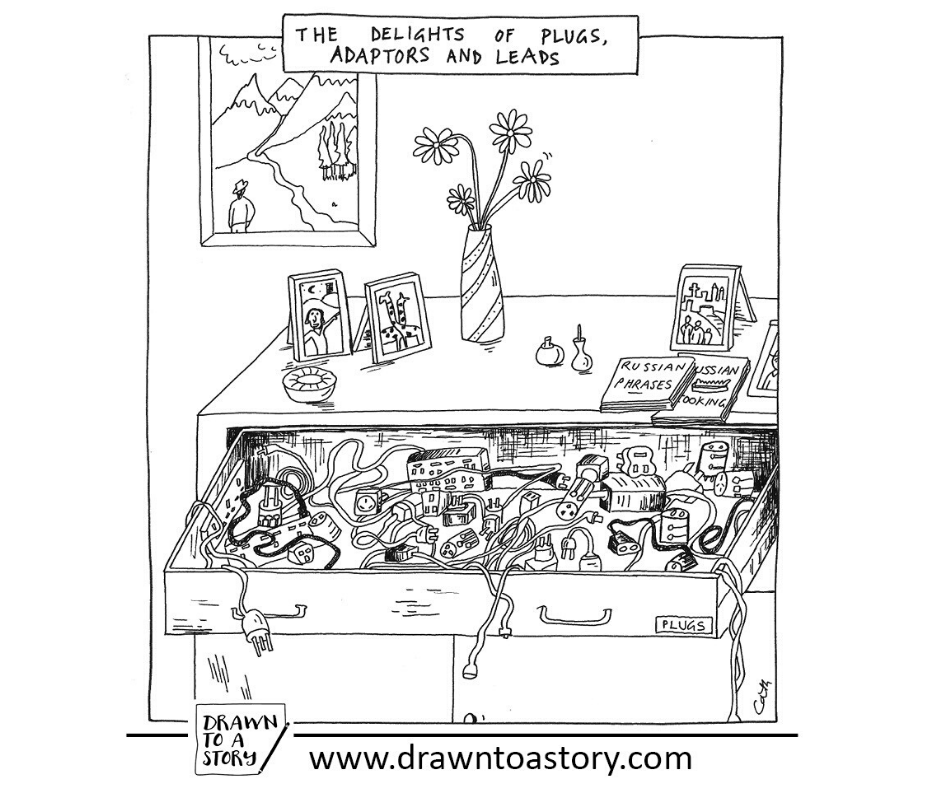
It’s okay. I’ve still got the ubiqutious ‘junk drawer’; it just now resembles a drawer belonging to the Ordered Drawer Brigade. I cleaned it up. I had to.

It resembled my cartoon below.

I’m guessing that if you’re an expat, you’ll also recognise the drawer of travel adaptors, plugs, cables.

When I’m unable to travel, they’re my lifeline to the outside world – a comfort blanket with the following words sewn in: Travel is always possible if you have the adptors, plugs and cables.

I’m reminded of a massive safety pin/nappy pin. The cheeky side of me wants to say, ‘It all goes to shit if you don’t use one’, but I’m not that rude.

But the adaptor and plugs ARE like the safety pin that I use to store my other safety pins.

They all fit together, but it’s not quite how you’re meant to use them.

The travel adaptor drawer is the same.

Numerous plugs and cables looking like they all go together, but each having a very particular purpose that is only effective when fitted correctly.

But all is not lost.

Stillness and Order

I think the travel adaptor/plug/cable drawer allows us to create order in our life.

In the chaos of the mess, a stillness arrives.
Each travel adaptor releases a memory of a holiday to another country or the 2 years you lived elsewhere. I even remember hotel rooms in which they featured or cafes I’ve worked in and had to rush back to to collect the plug I accidentally left in the wall.

Each of these plugs and adaptors act as a key to unlock my memories. Memories that connect me to my soul food: Travel and Connection.

Soul Food: Travel and Connection

It may sound unusual to read so much into the travel adaptor drawer, but I find objects especially powerful for deciphering the intangible – That stuff we know in our gut but can’t quite verbalise. It’s hidden, it’s within us and it’s where we make meaning.

So it seems that the humble travel adaptor is quite powerful after all. Even when it’s been used within an inch of its life and we think it’s not connecting to the power source, it works mighty fine. Have you considered connecting it to its other power source?

YOU.

Yes, by all means buy another adaptor to operate your iPad, but use the other one as a key. Turn the lock and revisit your memories. You might find that the crappy adaptor that barely ever worked, now makes you envious of the time you shared.

Now, if it would just f*****g fit into the wall.

Posted on — Leave a comment

The Disappointment of Realising You’re Racist

I’M RACIST.

No joke.

Unfortunately I’m deadly serious.

That’s not something you want to discover about yourself.
Racists are those people that I Ioathe. The ‘less than’ people I see on the news being arrested for hate crimes.
The people I disassociate myself from because….

I’m well-travelled.
I’m educated.
I’m cultured.
I have friends with different coloured skin.
You need to know that as I write this, that my whole body is creasing up in discomfort.
It’s the pain of realising that I’m no different to the ‘less thans’ and I’m trying to not feel ashamed.

I want to run. Badly.

Every cell in my body is fighting this admission. I hate it.
And now I’m crying. I feel like I’ve hurt my dear friends who have different coloured skin to me and I hate that even more. They don’t even know that I’m racist… but I feel like crap for actually being secretly pleased that I’ve been able to hide.

F*** This. Is. Hard.

Our street in Harlem

Last October I spent a week in Harlem, New York.
It was incredible and it was hard. Boy was it hard. It’s taken some time to process and has led to me sitting here, writing to you.

My wife is an Archbishop and her denomination’s Synod was being held at their church in Harlem.
I went along for the ride. I think my exact words were, “you’re not going to New York without me!”. It was my dream city and I’d never been before. For ease of access to the church, we stayed in Harlem.

And then it began. Five days of realising I’m racist.

So how does that happen?

MISGUIDED ASSUMPTIONS

His words were, “with all due respect, please do not compare your sexuality with one’s race. It is two totally different things.” I was affronted at his assumption that I was like ‘the others’.
I got it. Really I did!  I didn’t.
I’ll just reframe my point because he’s just misunderstood me. He hadn’t.

De-Dee Loft Davis is a racial equity consultant I follow on Linkedin. She’s great. About 2 months before New York I’d commented on a post of hers (how WOKE of me eh?) to show support that I understood the micro-aggressions Black people experience, because I get them too as a gay person.

It started a conversation between me and another racial equity consultant – a guy who continued to say, For me, most can hide their sexuality. I cannot hide my Blackness. It is what you see. I understand what you are trying to say by, “Sit in my shoes,” but I really don’t like when people try and compare the two. Both identities should be able to stand on their own.

I still didn’t like it. I really wanted him to understand my position. He wasn’t listening. (I know…..) He didn’t understand my gayness. I continued my argument, reframing and adding more points from my angle. This would make him understand (Don’t say it. I know…).

Suddenly I stopped.
I don’t know why, but I remembered something that Catrice M Jackson had said in her book ‘Antagonist, Advocates and Allies: The Wake Up Call Guide for White Women Who Want to Become Allies with Black Women’.  See I knew I wasn’t racist; I was reading the right books.

Essentially one of Catrice’s messages is simply to shut up and listen.
LISTEN to Black voices.
LISTEN to their experiences.
LISTEN to what they are telling you.
TRULY LISTEN.

So I listened and then I apologised to him. I did come to understand his point.
However, I still managed to tell myself that this was a one off experiences of me misunderstanding.

There’s that blindness of privilege again eh?

A FALSE SENSE OF SECURITY

Fast forward a couple of months to Harlem – grab a coffee and walk to the station to head Downtown. Ironically I was on route to give a talk to Families in Global Transition Tri state affiliate about identity, belonging and the biases we hold.

I’m feeling confident as I walk. Slightly excited at being here. Yeah I’m in Harlem. I’ve always wanted to come here. I’m an ally. I want to show support.

My naivety hit me hard. I smiled at people. Nobody gave a crap.
In fact it felt the opposite. It felt hostile.

And there were two hostilities, but I realised that they were both inside of me.

The first? I was desperately uncomfortable and trying to not look privileged. I couldn’t hide it. I’m a white woman walking down a street called Malcolm X Boulevard. That’s enough.

And second, (now I’m really trusting you with this), it became apparent to me how different my body felt when I walked past Black men. It hesitated and it felt anxious.

I tried to tell myself that it was because I’m a woman and we’re good at keeping ourselves safe in public, but deep down I knew I wouldn’t have felt it so acutely if they were White men.
I was ashamed and felt awful. I even found myself blaming them for making me feel this way. Nothing like a bit of projection eh? But I did want to understand why my body spoke to me this way.

I’m still wrestling with the why, but what I can offer for now is:

  1. My thoughts about Black people have primarily been developed through White eyes (mine and other people’s)
  2. My life has been very White. Yes, I’ve travelled widely, but observing is not living the truth of someone else’s life
  3. So much of the media talks about crime and social problems in Black communities, when in fact there are also many problems in White communities
  4. Somehow, the biographies and stories I’ve read about Black people, compartmentalise in my brain as separate individual cases, rather than evidence of a greater status quo of discrimination. I mean how much evidence do I need? Seriously? Again. Privilege.

YOU’RE JUDGED FOR BEING WHITE

I was completely ignored as I walked around Harlem. No one smiled at me. No one said anything to me. No one made eye contact of any description. But if you’re White and thinking that’s normal for any city street, watch what happens when you’re next out and about where you live. You receive subtle acknowledgements all the time. A sorry when someone squeezes past you, a quick stare if you’ve got a slogan on your shirt, people stay on the footpath when you walk towards them or they might give you a smile.

I got nothing. Like A.B.S.O.L.U.T.E.L.Y nothing.

In shops, the cashier talked to me as in, ‘that’ll be $5.99 thanks’, but if I said anything else it was completely ignored.

I felt like I wasn’t welcome. I wasn’t.

And why should I be? Centuries of slavery, discrimination and aggressions towards Black people and I think I can be welcomed as I venture into their safe spaces? Their communities? The reality was starting to hit me.

The reality hit even harder when I walked down the street with my wife dressed in her clericals. Her Bishop’s collar received welcomed smiles, greetings, Hello Padre – yes, padre! 🙂 In the laundromat where we’d been met with disdain in the morning, we were now offered a staff machine and all the help we needed.

My wife in clericals and me.

Previously, being White was enough to be judged. I hated what my skin represented. I wanted them to know I was different to ‘other white people’, but it didn’t matter. It was irrelevant. I was now experiencing what it was like to be judged for the colour of my skin.
It’s shit by the way.

Having struggled enormously when my wife became a priest (suffice to say, I didn’t like religion much), the irony of her giving me warm passage through the streets of Harlem was not lost on me.

You see, one less barrier existed. One less potential agitation removed. The collar bridged our differences and mutual fears.

I found myself wanting to leave Harlem, because I felt uncomfortable. I wanted to go back to blending. And then it hit me again. Blending is not an option for Black people. Unless they’re in Harlem. And then there’s this stupid White woman walking down the street…..

That’s gonna piss anyone off.
Privilege.

And you know the really awful thing? When I was in Harlem, I wished I had black skin, so I could blend and then I thought about what that really meant outside of Harlem and I didn’t want it.
Not because I think being Black is in anyway ‘less than’, but because I wanted to be accepted and not judged.
Privilege.

REALITY HITS

One of the fun things about New York is all the snippets of conversations you overhear when people walk past talking on their phone.

On this occasion I wish I’d heard differently.
A group of guys sitting on the front steps of a house.
Yeah, he’s dead. They said, ‘Stop! Freeze!’ then shot him. He’s dead.

The laundromat’s bathroom walls

This wasn’t a TV cop show or a social media post that you can distance yourself from.
The reality of their faces said everything.

I was now starting to truly listen. Minute snippets of truth slowly sinking into my tiny brain.

A couple of days later, Atatiana Jefferson was shot in her own home through her bedroom window by a Fort Worth police officer responding to a report that her front door was open. Moments before, she had been playing video games with her nephew, heard a noise and went to the window.

She’s now dead.

Black people are subject to deadly force even when they stay home.
I have never worried for my life when the police come to my home or when they’ve pulled me over in my vehicle. Privilege.

Poignant graffiti on the subway

RELIEF AND GUILT

It became time to move to another hotel Downtown. Synod was over.
I was relieved to be leaving the tension of Harlem.

This relief was also distinctly uncomfortable, because I knew that I could simply walk away from the discomfort I’d felt. It was an easy option for me. I could return to privilege without any effort and if I wanted to, forget about my experience ‘north of Central Park’. I could slip back into the melting pot of New York’s diversity and everything would all be okay again.

But it’s not.

What is not okay is not doing anything about it.

A switch has been turned on and I can’t turn it off.
I don’t want to.

The challenge for me personally is to work out what I’m going to do about it.

It starts with this blog.

In reading Catrice Jackson’s book, I had hoped to be classified as an ‘Advocate’ with the aim of moving to ‘Ally’.

However, my well intentioned, but misguided comment on Linkedin puts me in the Antagonist camp. I am not proud of this. But I’m also not afraid of difficult conversations.

So for me, it’s back to Catrice’s book to learn how to move forward into ‘Advocate’ and ‘Ally’. It’s too important not to.

Who’s with me?
It’s going to take more than one coffee to work through this one.

Posted on — Leave a comment

New Kids on the Block – Again !

What have I got myself into? she thought.

Simultaneously, her wife thinks,
What have I agreed to?

Neither says a word. That is, until….a man walks towards them, beaming with a big smile. Welcome to Taiwan. I’m Pin-Jui from the company. Let me take your bags and settle you in to your new home.

They reply: Fantastic Thank you. I can’t wait!  Me neither, I’m so pleased to be here.

Sound familiar?  Expatriate postings are like those extreme sport team-building days. There’s tension in the air, but you’re not quite sure if the adrenalin is exciting or terrifying.


My good friend Sundae Bean, says that as globally mobile people, we live ‘Olympic Level Lives’. Believe me, she knows her stuff. She’s an intercultural strategist and solution-oriented coach who also lives this life.

She right. This life kind of takes you apart, then puts you all back together again, many times over. And that’s now in 2020 when we are at a all time high for ease of instant communication. What about 10 years ago? 20 years ago? Or even more than 50 years ago?

It’s almost unfathomable to me. Imagine setting off in the 1920s unsure of where you’d end up and when – or if – you’d ever see your family again.

This first illustration from my book, ‘Living Elsewhere’ sets out some timely perspectives.

So what’s it been like through the Years?
There’s nothing better than words from the people themselves. For this, I have turned to my trusty resource, ‘The Source Book’, which I bought from the Expatriate Archive Centre in The Hague in 2018. This wonderful centre describes itself as a home for expat life stories.

So with my copy of The Source Book at hand, let me introduce you to our community of life-builders, the heroes, the brave, the determined, the emotionally resilient, the fiesty, the inventive, the survivors, the thrivers, the problem solvers and the inordinately adaptive people we call expats.

As you read on, I invite you to think about the skills developed, the lessons learned and the life review that these remarkable experiences trigger.

Take a moment too to reflect on each ‘PAUSE FOR THOUGHT’.

1920s

Malaysia in the 1920s

The day for my departure came so, in 1926, with my two small daughters. I embarked on the P&O liner ‘Morea’ at the start of a six week journey to a place called Lutong, Miri, Sarawak. At last after four weeks we reached Singapore…and were met by my husband… After nearly a week sailing over the China Sea we arrived off the coast of Sarawak….

On our arrival at the Lutong wharf we were met by the company men, Chinese coolies[sic], with four wheeled trolleys. Sitting back to back we were pushed through the jungle along a rentus (track) for two miles… our luggage on a following trolley, and so we arrived at the bungalow that was to be our home for six years.
– JG about EM, Malaysia, 1926
[The Source Book, page 035, EAC Ref 0500/479]

PAUSE FOR THOUGHT:
How would a long journey like this help alleviate arrival culture shock and subsequent transition?


1960s

Husband in Prison

My husband was one of the many rounded up and put in Seria Police station. The rebels took possession of all the cars. One night…some of the hostages were taken in a truck to part of the road near Panaga Police station. They were lined across it and used as a shield and were caught in the crossfire between Police and the Rebels. One man was killed and several others were badly injured. Lachie had been a POW for five years during the war and there was no way he was going to be locked up again. He escaped across a bit of jungle.
– EM, Seria, Brunei, 1960s
[The Source Book, page 75, EAC Ref oacl/33/4/1]

Civilities in the Aftermath of Civil War

I heard the door being kicked heavily, and, as I turned to see what was happending, a soldier, gun pointing towards me, propelled himself through the new open door…. Unable to speak I simply raised my eyebrows – “I want your school closed down now” he demanded. “All right” I finally managed to quake, no problem at all – can we discuss this?”

As the gun began to drop slightly lower and away from his face, I realised he was looking as frightened and unsure as I felt. Throwing caution to the winds, I asked him in what Province he had been at school… The gun lowered, he relaxed and we leafed together through one of the standard English texts in use in most primary schools. He had wanted to continue his education, but the army provided a surer living….
He finally confessed that what he had come for was to ask me to provide…some space for use as a polling station. Together, we toured the compound and decided that one classroom nearest the entrance would be quite sufficient…. As we parted he almost shoook my hand – but his gun got in the way.
– AR, Nigeria, 1960
[The Source Book, page 119-120, EAC Ref 0401/54]

PAUSE FOR THOUGHT:
Have you and/or your spouse worked out what are your non-negotiables? What scenarios have to happen for you to leave the country? Natural disasters? Civil unrest? Threat and experience of violence? The currency become vastly inflated?


1970s

Tanker Hit by a Missile
I was taken to the Graille Hospital in Saigon and eventually operated on to take the shrapnel, glass shards and burnt wire strands from my many wounds I had to my side, shoulders, head and neck, and then was stitched up well vaccinated with a syringe the size of a stirrup pump.
The French surgeon wore shorts, a flowery shirt and flip-flops on this feet, with a Gauloise cigarette haning from the lips, ‘picture the scene’…. and asked Carol to come and watch while he operated, no anaesthetic, of course…. just like out of war movie, only this was for real.

– CM, Vietnam, 1972
[The Source Book, page 98, EAC Ref 0905/763]

PAUSE FOR THOUGHT:
What has using local medical services made you grateful for?
How do you actively apply that gratitude in your life?


1980s

First Week in Bangkok
In our first week I was browsing through an antique shop and asked the owner to recommend a good rug dealer. He stared blankly, so I squatted to show him the floor. “Ah Toilet!” he said delightedly  and ushered me to the back of the shop.
– CC, Bangkok, Thailand 1984
[The Source Book, page 41, EAC Ref 0600/166]

Hidden Talents
Women may not drive, cycle or employ female domestic help. Some feel they are living in ‘gilded cages’…. Homesickness can be a real problem especially as extended family members may not visit and living in such a restrictive atmosphere can lead to paranoia and depression in various degrees.

Officially we’re not allowed to gather in groups and certainly not mixed (male and female). We are extremely fortunate however, in having a great GM’s wife who pointed out that we all have talents which we should use…I have just set up a small mixed choir (no previous experience in conducting!) and we plan to have a house concert very soon: prohibited of course and we have to leave out potentially provocative words.
– PH, Saudi, 1984
[The Source Book, page 57, EAC Ref 0007/732]

PAUSE FOR THOUGHT:
In what ways can you ‘get creative’ and use your talents to create great connections and purpose in your life?


1990s

Prohibited Equipment
When our seafreight arrived in Nigeria, we were informed that the agent had been thrown into prison because customs had found consignment of military uniforms in our possession. What?! In fact my husband had an old pair of camouflage trousers he used to wear when photographing in the Gabonese jungle…. He was summonsed before the General at the military base to apologise. [Shell paid a large sum and the agent was freed]

… A similar thing happened to friends of ours a couple of years later. They were accused of importing ‘espionage equipment’. This was in fact a small canoe acquired for their children.
– KM, Nigeria, 1997
[The Source Book, page 70, EAC Ref oac5/1/1/12]

A Guide to Etiquette in Delhi
The plumber – sadly everything leaks but he will persist in his repairs and come immediately. Sadly he fails to understand why we want the luxury of water out of both taps.
– SP, India, 1995

PAUSE FOR THOUGHT:
The best cultural interactions occur when both parties feel ‘met’. How do you deal with challenges within another culture? Do you only see it your way, or are you able to stop and meet them in the middle? If your way is not working, perhaps try another option and open yourself to their cultural approach. What have you got to lose?


2000s

Bacon and Eggs
We knew we were moving because mum offered us bacon and eggs for breakfast
– GL reporting words of her son CL: Den Haag, 2005
[The Source Book, page 122, EAC Ref oac5/6/2/7]

Relocating with Special Needs Children
When a family of a child with special needs learns of a possible international relocation, the rug literally is pulled out from under them. Even when research and treatment may be more advanced in the new country, parents need to learn an entirely different system, understahd the cultural context of special needs, and rethink best practice when considerable time, energy, thought and effort already have gone into the project. There may be insurance issues to be explored or mastered.
– LP, London, UK, 2004

[The Source Book, page 103, EAC Ref 0100/4/3/2]

Boarding School
I don’t know anyone who sent their children to boarding school because they wanted to.
– AM, Den Haag, 2005
[The Source Book, page 123, EAC Ref oac5/6/2/22]

New Habits
My husband never drank alcohol until we went to Nigeria.
– KM, The Hague, Netherlands, 2006
[The Source Book, page 101, EAC Ref oac5/6/5/7]

PAUSE FOR THOUGHT:
How we behave off the situations that present themselves to us can dramatically influence our mental and physcial health This includes what we’re like to live with and work with too. How can you transform your choices that you choose through gritted teeth into ones taht you welcome openly, warmly and with purpose?

I hope that you can grace me a minute to remind you of the words I used at the beginning to describe expats:
Life-builders, the heroes, the brave, the determined,the emotionally resilient, the fiesty, the inventive, the survivors, the thrivers, the problem solvers and inordinately adaptive.

I don’t see how we can see them as anything else. Do you?
They’ve worn their shoes well.
So well, they might need to retire them, but that’s another blog for another day.

Cath x


“No matter what the situation, remind yourself, I have a choice”

Deepak Chopra