I’m truly excited to announce that Drawn to a Story’s NEW ONLINE SHOP is launching soon!
Since publishing my book Living Elsewhere, your feedback has been overwhelming.
Firstly, THANK YOU! I love hearing that the book is so well received!!! It really makes my day.
You are a genius, so subtly articulating what we feel but don’t find the words to express. Thanks and my deep recognition. Please make volume 2! (An expat in Sweden)
Even my kid looked into it and did not put it away. That is remarkable as he ‘hates’ expat things! He said it was really like that. So thank you for making this! (An expat in Taiwan)
Secondly, YOU HAVE SPOKEN! Lots of you have asked me for more illustrations and more products! I have listened to your passionate requests and am thrilled to ‘give the people what they want’!
And so…. I am launching a NEW ONLINE SHOP.
What can you buy in the shop? Mugs, journals, t-shirts, cards plus loads more – all featuring Living Elsewhere cartoons. You will also be able to buy expat/third culture kids/cross cultural kids themed items. We will also be adding to our collection regularly, so stay tuned for updates.
When will the new shop launch? In March I’m presenting at the Families in Global Transition (FIGT) Conference in Bangkok. It’s such an incredible gathering of people living globally mobile lives. Check out Releasing the Spoon to learn how mindblowing and life changing my first conference was.
Sticking to the theme of ‘Releasing’ and FIGT, the shop will launch in the first week of March, right before FIGT2020 starts!
Follow us too – We will be posting all about it on social media in the lead up to Bangkok.
Why do you choose to sit where you do in a restaurant?
Noise levels? Away from the toilets? By the bar?
Or maybe to protect yourself? Huh? Protect yourself?
Yes. Stay with me on this. Just before New Year’s Eve I was enjoying dinner in a resturant; one where you choose your table yourself.
All the diners had arranged themselves roughly in the centre of the restaurant, except for one table.
Sitting in the furthest corner away from any other diners and under a loud TV was a family; two parents and their adult child who had an intellectual disability. They were distinctly separate; removed from other diners.
Now, humans are fairly predictable. We follow well-worn paths. We clump together. We struggle to be random, even when we try to be. For example, you can tell if someone has fudged their expenses because they will often include numbers ending in a zero or a five.* Yes really. Don’t get any ideas! (*Is this where I enter my disclaimer?)
I admit that there may be a myriad of reasons why this family were separate (other diners had since left or they liked the TV? etc), but I couldn’t help but wonder if they’d removed themselves because of their son?
And the minute I write that I want to correct it. Not because of their son, but due to a fear of how people might react to them. We naturally want to protect ourselves. Who wouldn’t?
I know too as a gay woman, how much my own public behaviours are modified to remove any chance of being hassled, stared at or jeered. You self-select your protection measures.
Insight 1: DISCRIMINATION can create ISOLATION on route to PROTECTION
There’s oodles of research out there which proves that people with intellectual disabilities are discriminated in restaurants and cafes.
Do an internet search if you want statistics. It’s real and it’s about as polar opposite as you can get from Belonging.
And within the context of our globally mobile lives, disability adds a layer of complexity. Do you admit to employers that your adult child needs to travel with you and has extra and different needs? Subsequently, you wonder if you will be as employable if the company perceives your family to have additional cost implications? For example, you need to live near health facilities or require a house with no steps etc.
So you don’t say anything, but you feel guilty. You feel guilty because what does it mean if I don’t say anything? Does it matter? Well, yeah, because it’s like I’m hiding. Does that mean I’m uncomfortable by my family’s difference? No. I’m just scared about how I will be treated. I want to be open, but if I’m completely honest, I worry that…..And so the thought cycle goes round and round. It’s exhausting.
I have a friend who works internationally in the developing world and travels a lot for work. Picture rural areas, broken pavements, pot holes, footpaths covered by market stalls, animals lying in your path, stairs not lifts etc. She clearly impressed them in her interview as she got the job. The first they knew of her wheelchair was when she entered the interview room.
Now, imagine that.Reallyimagine that.
Think of the emotional energy that goes into removing the chance for discrimination. The excitement you feel at getting an interview takes a hit when you imagine the potential discrimination and previous experiences of ‘not suitable for the job’. You try to work out how much it matters to you; whether or not you want to ask for the disability assistance that’s available for the interview. NO, let’s remove all chance of discrimination and just turn up. This protects you emotionally whilst holding the uncertainty of how it will be received. That’s all before you even get to the interview.
That’s a lot of emotional energy that could be redirected into more positive things.
Insight 2: INCLUSION removes wasted energy and creates a sense of BELONGING.
I’m not sure that people who are resistant to diversity realise that inclusion is going on all around them. They just don’t see it. And in many way they’re not meant to. It’s not for them.
It’s a bit like a hidden code – only seen by those who can read it. For example, my wife wears a sunflower lanyard when we go through airports. It shows staff that she has a hidden disability and might need assistance. A rainbow flag sticker on a cafe door shows me it’s a safe space. A rainbow badge worn by the nurse and doctor in the UK’s National Health Service tells me I’m seen.
Cartoon produced for Families in Global Transition.
These visual cues are so important. We all know to be careful walking near someone with a white cane. It is no effort for us, but makes the world of difference to that individual.
BUT, we still need to listen and not assume that we understand the code. We all speak different emotional and observational languages….. and if we go back to those *fudged expenses (*ahem…insert another disclaimer here), we need to remember that we struggle to be random. Based on our own set of cultural and social reference points, we tend to assume that our own observations of an individual’s behaviour equals that person’s intentions. Mostly, it doesn’t.
I suspect that we’ve all stomped along that well-worn path of human predicatibility at some point in our lives.
Insight 3: ASK FIRST – Always! and FOLLOW THEIR CUE
We’ve all heard the story of the elderly ‘disabled’ person who is ‘helped’ across the road by the well-meaning but misguided champion, only to inform them that they in fact weren’t waiting to cross the road.
Only last week, after my wrist operation, the nurse said, Wear your sling in public so people know to be careful around you. You’ll probably get someone trying to take you across the road!
A cartoon from my book Living Elsewhere.
A few years ago, we were in Glasgow for my wife’s work. As we stood at the pedestrian crossing waiting for the lights to change, I saw a woman in a wheelchair coming towards us.
Oh no! Angie! There’s a woman coming towards us in a wheelchair. I don’t want her to think that we’re ‘taking the piss’. (For non-Australian and non-British readers, this means to make a joke at someone else’s expense).
So picture this. Angie and I standing by the side of the road with Ichabod (her ‘rubber man’ as she calls him) in his wheelchair and his granddaughter, Jessicha on his lap.
The woman approaches. I now see she has britle bone disease. I’m hoping she goes straight past us and doesn’t see us. But of course no, she pulls up, right next to us to also cross the road. The five of us in a row, waiting like peas in a pod – sandwiched together between two traffic light poles.
Angie and I stare straight ahead, trying to act as though wheeling a rubber man around in a wheelchair is normal. Mind you, he’s quite life-like so people often don’t realise that he’s not real.
And then I see her. I see her slowly turn her head to look at Ichabod. The look of surprise is palpable. She opens her mouth to speak.
I wait, worried.
And then in a broad Glaswegian accent she says Aye, and there I was thinking I was the special one! before laughing uproarously.
I’m fairly sure I then embarrassed myself by chatting to her waaay too enthusiastically. My relief burbling out with freaky friendliness.
It is also safe to say that I didn’t ‘style it out’ particulary convincingly.
But I didn’t care. She showed me how to ‘style it out’ like a pro.
Thank you Glaswegian woman. You taught me well that day.
EVERY. SINGLE. TIME. Every single time we lump people together, humanity takes another hit.
We lump. We like to lump because it’s easy. We lump people together as though we’ve grabbed a bag of oranges and chucked them into our grocery trolley.
A bag of oranges here. A packet of dates there. A box of biscuits. Different food groups, but all the same within their collective packet.
It’s the reason that supermarkets, haven’t offered (until recently) imperfect fruit and vegetables. We like symmetry and we like to lump together.
Captioned as ‘ugly’ in a stock image library.
Captioned as ‘ugly’ in a stock image library.
We like to lump together when it comes to people too.
We do it with nationalities. We do it with gender. We do it with religion. We do it with….. well, everything.
It’s easy isn’t? But have you noticed that we only do it when our words have derogatory intent?
When was the last time you heard someone say, Oh that’s so typical of women to be amazing at juggling family life and work? or maybe, Typical men, they’re so good at raising their kids.
Me neither. We lump together and generalise when we want to slag off or have our misguided judgements confirmed.
Oh yeah, but that’s not always the case I hear you say. I wouldn’t say that because some guys aren’t great at raising their kids.
You’re right, They’re not, but I challenge you. Do you afford the same positive variations and distinctions when generalising in a derogatory way? Do you say, Ah, typical men!or do you pause and say, that’s so typical of a certain type of man?
Generalising Isolates and Incites Hate I’ve seen it. It’s not pretty. In fact it’s horrid. Social media is not kind. Faceless ‘warriors’ influencing and creating fear against certain people. Massive generalisations.
Transphobia. Xenaphobia. Islamaphobia…to name a few.
I feel fairly helpless in my ability to affect change. I speak out when I can. I’ve been described as difficult for doing so, BUT:
I have to. I find myself thinking of beautiful moments I’ve had in mosques, of visiting Syria and never feeling so welcome in a country as I did then, of Muslim friends, of reading about women having their hijabs ripped off in the street by strangers or the increase in racism after the Brexit vote…..
and I know that however helpless I feel, I am always in a position to do something positive.
Me with the lovely Omar fixing our broken down car in Syria.
On route from Palmyra these men with their massive grins kept jostling for pictures
Inclusion and Being a Friendly Face is Not Hard It’s not till you see someone else’s every day, that you realise the reality of why we need to reach out.
On one of my last trips to the USA I was standing in a slow security queue at an airport. People were starting to get irritated at the delay. The security team were being extra thorough on one person. A muslim woman and her 3 year old child.
People smiled as he played behind her, leaping onto anything he could climb, but at the front of the queue you could have cut the air with a knife. The security guys were doing their best to be polite, but there was a massive elephant in the room, stomping down the conveyor belt.
I swear I heard it blow its trumpet, at least twice. Once when they insisted on putting the woman’s bags through the scanner for a third time and again when they offered to repack her now completely jumbled bags. She fought back tears as she grabbed her bags; all her belongings falling out. No, I’m okay. I’ll pack them myself, she said, clearly desperate to get away from the public spectacle.
It was awful to watch. We all knew why she’d been stopped, but no one said those words…. Muslim woman.
A few minutes later I was in the toilets and realised she was there too.
Excuse me, do you always get that level of detailed checks?
Yes.
That broke me. I placed my hand on my heart and through tears said,
I’m sorry that you have to deal with that. It’s not right.
I’m used to it.
You shouldn’t have to put up with that. I’m so sorry and for your children to see it too.
She shrugged,
I’m used to it. It happens all the time.
By now she was crying too. She leant forward to hug me. There we stood in the bathroom, two strangers in tears, hugging each other.
And the incredible thing…? I spoke to her to give her comfort, but in reality she gave me comfort. That experience of ‘other’ was new to me. THAT reality check of someone else’s life.
How is it that we’ve got to the point where the victim is the one who reassures the privileged? And because they are so used to being treated as ‘the other’, it’s become their normal.
That frightens me. I do not want to live in that world.
So I’m making a plea. I hope you’ll join me.
Next time you go to generalise, please think of the woman in the toilets.
Please think about the personal impact generalisations have on her and her son – the new generation growing up knowing they are ‘other’.
Please be the person who doesn’t generalise. Please be the person who speaks out. Please be the person who sees individuals.
I’d like to challenge you to think about this current cusp of transition from 2019 into 2020. It’s not just a new year that approaches. It’s also a new decade.
2019 is almost due to be stored on the shelf
We live in cycles of time. Ten year turning points are momentous and are often the pivot point for big life decisions or the end of a difficult period and the subsequent start of putting those lessons into action.
Where do you feel you’re positioned as the transition looms?
I’d like to adulterate Brad Paisley’s quote: “Tomorrow, is the first blank page of a 365 page book. Write a good one”… With….. “Wednesday is the first blank page of the 365 sketchbook of life. Draw a bloody fantastic picture every day. Some days there will be merely a dot on the page. You turned up. That’s enough. Other days, the pages will be full of colour. At the end of the year, you’ll have an incredible record of your year.
Go on. Go rock it. Go live it.
Go and tear a few pages passionately as you attack the page!”
Okay, so I’m one day ahead of myself, but I’m giving you time to prepare 😉 And I’m an artist more than a writer, but that’s details details details people 😁
Challenge accepted? Who’s with me?
If you say yes please! you won’t be on your own. Write ‘yes please’ in the comments below and I’ll check in on you at the end of each month to see how you’re going.
Right about now your social media and Christmas letters are filled with friends and family enjoying mulled wine and egg nog around log fires or relaxing on the beach with a beer. It’s all about the festive season, hanukkah, holidays and family time.
As you enter the second half of December’s social media, I have a task for you.
YOU’RE NOT GOING TO LIKE ME I suspect. “Hey Ho” I say, without trying to sound like Santa.
TASK:
Place your hand on your heart
Be completely honest and truthful with yourself
Answer the following question
When you see your friend’s/family’s holidays activities on social media, are you genuinely pleased that they are enjoying themselves or are you jealous?
I’m the first to admit that I get jealous. Not always, but it’s there.
I even hear the words, ‘Why am I not doing that?’.
In seeing family doing something exciting whilst I’m at my desk or seeing a friend enjoying sun, as my windows rattle violently with the wind and rain, my mind wanders to imagine what else I could be doing.
I feel kind of vulnerable admitting this, as though it’s some sort of failure, but I often want to be somewhere I am not. I crave external stimulation and excitement. I want to be on the go, travelling and I thrive when I am. BUT, over the years I’ve also learnt 3 Valuable Lessons.
LESSON 1: People don’t post the hard truths of their lives.
We project our ‘best lives’ – a manufactured identity. We post the activities and experiences that leave us in a positive light. Unless we want sympathy, we don’t post about our financial woes, fighting with your partner about their parenting or your worries about whether you and your kids can cope emotionally with the next 2 years of your partner’s global job.
We know that much of social media is a modified truth. The activities being posted are real, but they are the skimmed down, cut and paste version of life. It’s sometimes helpful to remind ourselves to see them for what they are.
This is my reality.I POST ABOUT THIS We live by the sea and it’s wonderful…
…in summer.
This is my reality today. I DON’T POST ABOUT THIS * Headache * Walking home in the rain after I put the car in for a service * Cold, windy and wet * Worrying about a work deadline * Tired and wanting to stop work for Christmas * Missing hot weather Christmases from my childhood.
LESSON 2: Having a great holiday doesn’t exclude people from having had a sh*t year.
You might want the wonderful holiday your friend is enjoying and posting about, but do you also want the difficult year he’s endured?
When you don’t see someone’s day to day struggle, it’s easy to not appreciate their reality – and the very real need for a much-earned holiday. We don’t see the struggle so it hasn’t happened. We don’t see the hard work that goes into a tough year. We don’t see the tears, the anxiety, the frustrations. We see the celebratory times posted online and it’s easy to slip into jealously and wishing we were there too.
Stop. Step back. See your many blessings. Cherish that your friend is getting the break he deserves.
LESSON 3: The grass is not always greener
I love the expression, ‘the grass is always greener on the other side’. In thinking there’s something better than our current situation, this attitude could be mistaken as being a good motivator to improve one’s life.
BUT, it can sit within a context of comparing one’s life to another’s, wanting more without being grateful for what is, and forgetting that wherever you go, you take yourself with you.
It’s a disruptive state of mind. It leads to regrets. So, next time you feel yourself wanting to chase something greener, consider two of the key things that matter to us most, here at Drawn to a Story:
Identity
AND
Belonging
You are who you are and your sense of belonging begins within. I like to think that you’ve had a jolly good apprenticeship at being you (whatever your age).
Now is the time water the grass and become the ‘best you’.
I know that you know everything I’ve already said, but I also know that when I’m tired at the end of the year, I’m not at my best.
I’m guessing that you might not be too.
* There’ll be those of you who have not bought a single Christmas present yet. (No judgements here, that’s usually me!)
* Some of you are having everyone over for Christmas Day and you’re in a mild panic.
* And if you’re like me, I know some of you will be looking out the window at the cold weather and missing your hot ‘home’ country.
So, whatever your circumstance, remember…..
Every flier who ventures across oceans to distant lands is a potential explorer; in his or her breast burns the same fire that urged adventurers of old to set forth in their sailing ships to foreign lands Jean Batten
WE ALL NEED SUPPORT. Sometimes a little is enough. Other times, we need a whopping great big steel girder. These moments are usually the ones that catch us completely by surprise and whack us from behind, with no time to prepare.
You never know when they’re going to hit, so I like to prepare if I can.
But when you live a globally mobile life, the big steel girders can be harder to find, right? New friendships aren’t necessarily at that point yet. Old deeply nourishing ones may feel impeded by geographical distance.
Keep them at the forefront of your lives. Look after them in the way that maintaining the steel girders of a bridge keep its users safe.
Maintain your steel girders too. You are the user of your own bridge.
Don’t let distance stop the connection. There are always ways to keep your friendships nourishing, meaningful and as close as they’ve always been.
Yes, you might end up like me with an embarrassingly large number of WhatsApp screen hours, but actually, do I care?
No. Not. One. Bit. “Wha??” I hear you say.
The richness that these connections bring to me are life changing.
Distance is nothing. The connections, the commitment to each other, and the care that comes in all colours of the rainbow make me happy
I feel safe. I feel secure and I feel full. Find your steel girders.
Love the crap out of them and your bridge will stand against the fiercest of storms.
It might become a little cracked and dented in places, but these marks bear witness to a remarkable story of how the bridge survived the Force 11 storm of…. [insert your month/year].
So who today are you going to tell that they are your steel girder and why?
Have you ever thought, that what’s a one day joke for you, may be somebody else’s everyday of not belonging?
They may offer a smile in an attempt to be accepted and not offend your joke.
But what’s going on inside that person?
Maybe their smile yet again covers the sudden desperate weight in their chest that comes with a ‘joke’. It’s just a joke right? Banter, we all love banter don’t we? Yeahhh!
Yeahhh? Watch the video and after you’ve watched it, I’d love to hear your thoughts in the comments below or on our Facebook page.
I want to talk about spooning. Yep. Spooning. Now, there will be some of you saying, ‘Spoo……What?‘ and not knowing why it’s a loaded word. Others will innocently be thinking, ‘How lovely, I like to cuddle.‘ And lastly, there’s the ones who will have started to snigger. Yes, it’s a sex position too.
BUT, there’s more to spooning than you think.
In a few months time I will be speaking at the Families in Global Transition conference.
It’s mainly a conference for people who live a globally mobile life and the companies that operate globally.
A group of us who live in different parts of the world were looking at staying together. You know? Trying to work out how to save money and fit 5 people in a 3 bed place.
And the inevitable happened…
We started to joke about spooning. Well, you would wouldn’t you? It certainly kept us entertained on WhatsApp for an afternoon….
….and reminded me of nights travelling, four of you squeezed into the tiny spare room of the friends who’d kindly put you up for the night.
Dare I suggest the new hashtag #FIGTspooning?
But seriously, it got me thinking about FIGT…
The conference has a wonderful ability to make you feel like you’ve ‘come home’. Rather than being the odd one out in your host country, everyone in the FIGT room understands the quirks and challenges of living elsewhere.
FIGT2018 was outstanding.
It allowed me to breathe again…. I had finally found my people!
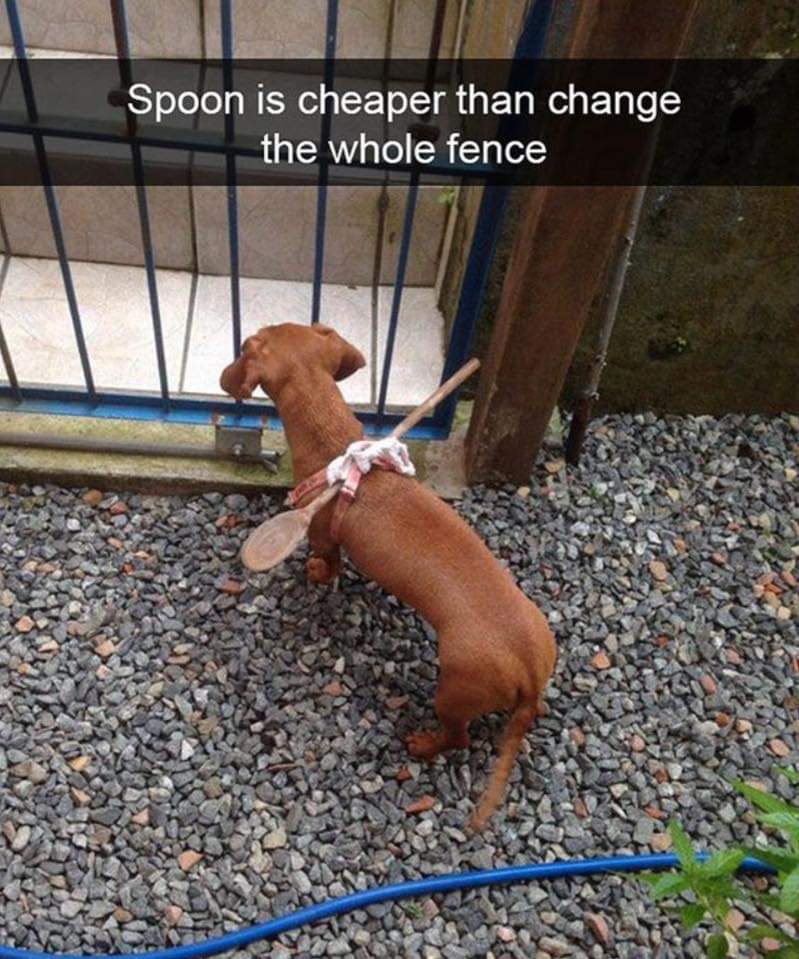
And then, this morning and completely unrelated…. another friend sent me this picture below of a dog – its owner cleverly using a spoon to stop the dog from escaping through the fence.
This brings me back to spooning. #sorrynotsorry
The spoon holds the dog back. It keeps him/her contained, with good reason no doubt, but it limits the dog’s adventures.
It would be so easy for someone to rotate that spoon or slip it out of the dog’s collar and as he ran free he’d be wiping away the tears of joy like we did in Free Willy.
You see, this is how I see FIGT… …as the hand that removes the spoon.
That hand that allowed me to breathe again. The hand that expanded my world.
Yes, I decided to travel to The Hague in 2018, but FIGT created the reason.
And it was a decision that changed my life.
I now have a new group of friends whom I love dearly and communicate with regularly.
I met my best mate at FIGT. It’s been an amazing year of laughing, talking, soul searching and deep connection.
I’ve started new projects off the back of #FIGT18….and emotionally,
I’m an entirely different person. I’m settled in a way that I hadn’t been for a long time.
Going to the FIGT conference sparked something that has fed me deeply this last year.
The night of one of the most profound chats of my life
I knew there were other Aussies attending as I found a Mintie on the floor!
FIGT really is a wonderfully diverse organisation that promotes cross-sector connections for developing best practices that support the growth, success and well-being of people crossing cultures around the world.
There’s a reason FIGT goes by the phrase, ‘A Reunion of Strangers’.
It’s not just big picture and big companies. In fact FIGT is the complete opposite. Rather, it’s about creating rich personal connections that thrive across the vast distances that we all live from each other.
I’ll be there this year again in Bangkok doing a Lightening Presentation and Living Elsewhere will be in the bookstore.
If you’re wondering about whether to come, definitely do! You never know where it might take you.
The loss of a loved one hits you like a cricket bat.
Square in the face.
And it hurts.
It hurts big time.
It’s multilayered at the best of times, but your best coping strategies are well and truly stretched when you live in another country. The distance between your souls is far apart, but you hang on to the knowledge that you will see each other again.
…and that’s before death hits.
You can cope with the distance, because you talk regularly on the phone, exchange emails and know that when money permits, you can travel to see each other.
There’s always that future time when you know you can sit in the same room catching up in a way that phone calls never seem able to do. Reminiscing with each other – enjoying the sound of their laugh or the wry look they give you. Each facial expression reminds you of another time that you managed to share special time together.
You learn to live with seeing each every 2 years, or once a year if you’re lucky. So you make it really good when you do.
And best of all, you always know that there will be next time.
Until there’s not.
My father died 4 months ago and I still feel like I’ve just been hit with that cricket bat. It’s not such a fresh wound. The bruises have gone. I now look like anyone else, but my eyes still water with the pain. Cricket bats are painful bastards.
Now, my comfort comes from a picture by my bed, a jumper and a poncho. Some days, just knowing the poncho and jumper are there, is enough.
Other days, they need to be smelled and his photo touched – my fingers trying to remember how the lines on his face moved when he laughed or how his beard felt on my neck when I hugged him.
THIS is why I’ve been quiet on here.
Hibernating has been essential. No, actually,
It’s been critical
I was lucky enough to be able to rush to South America where he lived to spend time with him before he died. A surreal time with loss and liminality using each other to balance.
I think they knew each other well.
‘Loss’ seemed more of a fragile character.
She knows that I was wary of her, but also that she would need to become my friend soon enough. We danced around each other, eyeing one another for 12 days.
We didn’t speak much.
‘Liminality’ on the other hand was more of a friend to me in that time.
She was quite down to earth, but kept disappearing on me. I didn’t know where she would go, but every time she did, Loss came forward trying to sneak her way into the room.
Once she even picked up the cricket bat by the door, but put it down again when I looked at her.
I knew I was only putting off the inevitable.
And the inevitable came after I’d flown home.
Unfortunately, Loss decided she wanted to play cricket…another 4 times.
To experience 5 significant deaths in 4 months has felt more like a round with Mike Tyson, than a cricket match.
It’s probably not a surprise to learn that I’ve decided to not play cricket for a while.
I’m happier at an away game drinking tea, watching from afar…..at least until my injuries heal.
If the captain asks me if I want to play again, I know what I will say.
“Yes, but as long as my dad can watch over me from the sidelines”
I remember as a child thinking I was terribly clever asking whether Brazil nuts were just known as ‘nuts’ in Brazil. Or asking what’s ‘Déjà vu’ in French?’ We all did that right?
As a kid? Silly games and playing with words as we began to learn about how to use them.
Back to the Brazil nuts though…. Apparently, they are not actually a nut (rather, a seed) and it turns out Bolivia harvests more of them than Brazil. And it’s not just Brazil; they grow in other parts of South America too.
But it got me thinking about labels. What narrative do you tell yourself about who you are? How do others describe you? Do you like the words people use?
We give ourselves labels every day. “I’m a doctor…” “I’m a singer…” “I am a white woman…”
I hear you say, “but these aren’t labels, They’re facts”. I think I agree with you on that one, but what happens when we use these ‘facts’ about other people?
In many ways it could be argued that we need labels to help us to function as a society. On a civil level, it protects our rights and entitlements to services (health, housing, social benefits etc) and also allows us to prove who we are.
But what about the labels that aren’t for government purposes? The ones which the newspaper touts as a headline like:
MIGRANTS take ALL new jobs in Britain (The Daily Express) or the Mail Online: How they make YOUR lunchtime sarnie: Migrant workers use their BARE HANDS to churn out three millions sandwiches a week... I refuse to link to the Mail Online, so here’s the Huffington Post article that discusses it.
These are fairly extreme examples, but they are real headlines from British papers. They incite hatred and provide a slow drip feed of hate and fear that isolates and demonises different sets of people.
And I hear you saying, “but that’s the Daily Express and the Daily Mail. They’re known for writing like that.“
Yes they are, but those headlines filter down to local communities and become the accepted facts. Too often no one checks to find out if the headlines are actually correct or what their motives might be.
I am a migrant, but because I look like I fit (white skin, freckles, red hair), I’m often taken as an insider and seen to be a safe space. A colleague once passed the time with a casual chat.
She started: “I’m sick of immigrants coming over and taking jobs“ “Hmm…well I’m an immigrant” I replied. “No, no, no you’re not.” “Yes, I am. I’m Australian.” Again, “no, no you’re not…”
I thought to myself, ‘but I’m not dark-skinned or Eastern European or any other ‘otherness’ that’s deemed ‘foreign’ am I? I really wanted to say that out loud, but I let it slide as it was a new job and I was worried about being seen to cause problems. I’ve regretted it ever since.
Yes I am a migrant in the UK, but when does that descriptor become a label? It comes when it’s used negatively against you. A while back a friend asked me what words I’d use to identify myself. I surprised myself by instantly saying, ‘red-headed Australian’. I wondered why and realised that at home in Australia this was a given. It didn’t need to be expressed.
My experience in the UK has been quite different. I am the one that is ‘not from here’, and referred to as the ‘foreigner’, ‘the ‘convict’, the ‘red-head’, the ‘ginger’, ‘ginga’ or the ‘colonial’. I’ve been in business meetings where people have talked about ‘drowning gingers at birth’. I’ve had people say, ‘another bloody arrogrant Australian’ when I’ve politely answered a question. Another told me that ‘all Australians are arseholes’ whilst someone else even looked at my ankle and asked ‘where is the ball and chain?’.
It certainly doesn’t make you feel welcome. I must point out at this stage that I have met many lovely people too and live in a wonderful community. The more negative comments are definitely not the majority, but they are said with enough regularity to have an impact.
For them it’s a throw away line. For me, it’s my every week, sometimes my every day.
So you decide to try to fit in more to make yourself less noticeable, not as open to the passive aggressive ‘jokes’. But you’re unaware that you have every chance of losing yourself. Without really realising, you slowly chip away at the fundamental descriptors that make you who you are. I ended up not sure who I was anymore and where I belonged.
In answering that friend of mine, with ‘red-headed Australian’, I realised that I had reclaimed that label as my own. It had unexpectantly and silently served as my recharge and my path back to my authentic self. I was lucky… actually, no, that’s not right….
I’ve worked hard to find strength and reclaim the labels given to me. I am grateful for the personal growth that’s come as a result, as some aren’t so fortunate. But it also makes me question.
Why did it even need to happen?
However, last week I heard the most wonderful talk by Dalia Elmelige, on Radio 4’s Four Thought. Her story of being a Muslim in America after 9/11 was fascinating especially her comments about being split between 2 cultures – Too Muslim for America, but not Muslim enough at home.
WHY DO LABELS EVEN MATTER?
They matter for two reasons.
The labels you use to identify others reveal more about you than the person you are describing. Labels are often a self-fulfilling prophecy that confirms to ourselves that we know who ‘they’ are. As a known quantity, we know how ‘they’ are meant to behave – i.e. within our chosen social norm. The ‘white’ person you describe may in fact identify as Aboriginal. The ‘woman’ over there may feel gender neutral. The ‘straight’ woman with her long hair might actually be a lesbian – yes, I had that said to me once, “But you’ve got long hair?” So how do you describe others? What are you revealing about yourself and your outlook on the world?
Identity labels put people in boxes. It limits them and it limits you. It feeds into accepted social norms of what it means to be this person or that person. As a result you shut down that enquiring part of your brain that uses all of the body’s receptors to explore and discover someone rather than already ‘know’ who they are. I’m not suggesting that we are ‘all human’ as is the trend these days. This reduces all the rich layers of culture, ancestors and rituals that form different peoples.
I’m suggesting: We ask rather than tell. We listen rather than speak. We observe rather than act in haste.
And to end….
Privacy & Cookies: This site uses cookies. By continuing to use this website, you agree to their use.
To find out more, including how to control cookies, see here:
Cookie Policy