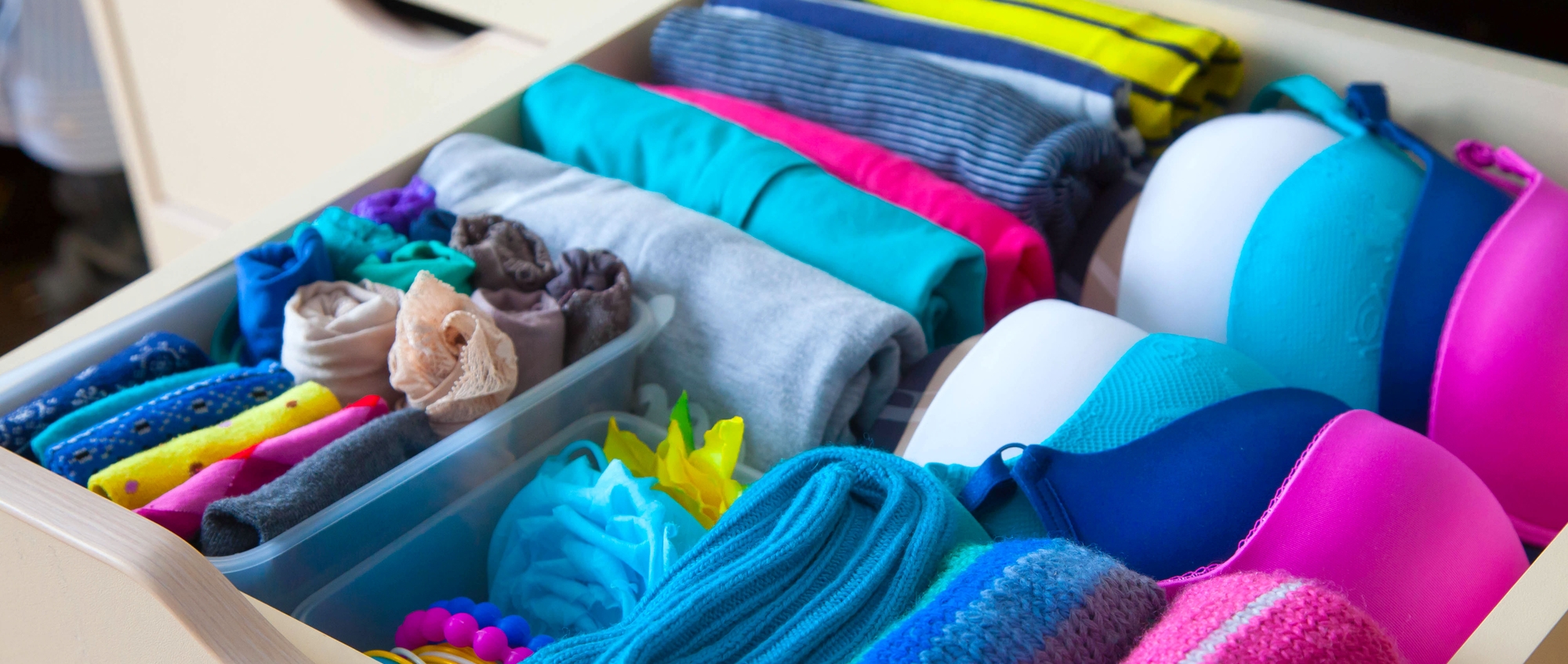
You know those people who have perfectly ordered drawers? Don’t worry. I dislike them also.
I have to be honest though. I think I’ve always been a little bit jealous. Again, don’t worry. I know you understand.
A few months ago, I decided to become one of those people. I’m a little nervous now. Are we still friends?
It’s okay. I’ve still got the ubiqutious ‘junk drawer’; it just now resembles a drawer belonging to the Ordered Drawer Brigade. I cleaned it up. I had to.
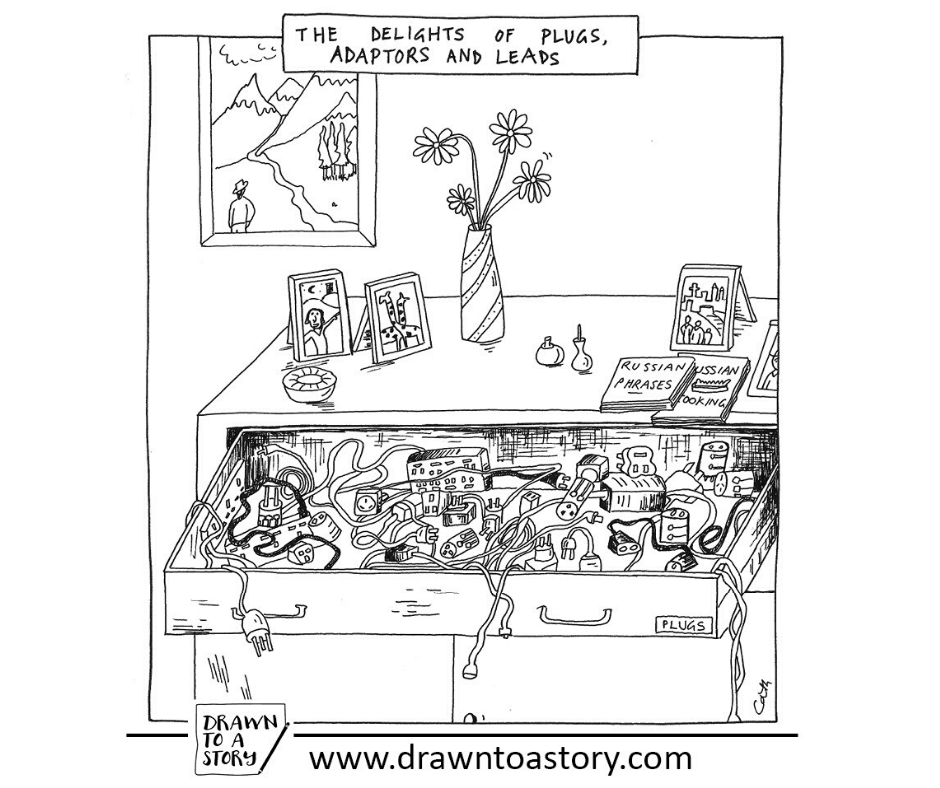
It resembled my cartoon below.
I’m guessing that if you’re an expat, you’ll also recognise the drawer of travel adaptors, plugs, cables.
When I’m unable to travel, they’re my lifeline to the outside world – a comfort blanket with the following words sewn in: Travel is always possible if you have the adptors, plugs and cables.
I’m reminded of a massive safety pin/nappy pin. The cheeky side of me wants to say, ‘It all goes to shit if you don’t use one’, but I’m not that rude.
But the adaptor and plugs ARE like the safety pin that I use to store my other safety pins.
They all fit together, but it’s not quite how you’re meant to use them.
The travel adaptor drawer is the same.
Numerous plugs and cables looking like they all go together, but each having a very particular purpose that is only effective when fitted correctly.
But all is not lost.
Stillness and Order
I think the travel adaptor/plug/cable drawer allows us to create order in our life.
In the chaos of the mess, a stillness arrives. Each travel adaptor releases a memory of a holiday to another country or the 2 years you lived elsewhere. I even remember hotel rooms in which they featured or cafes I’ve worked in and had to rush back to to collect the plug I accidentally left in the wall.
Each of these plugs and adaptors act as a key to unlock my memories. Memories that connect me to my soul food: Travel and Connection.
Soul Food: Travel and Connection
It may sound unusual to read so much into the travel adaptor drawer, but I find objects especially powerful for deciphering the intangible – That stuff we know in our gut but can’t quite verbalise. It’s hidden, it’s within us and it’s where we make meaning.
So it seems that the humble travel adaptor is quite powerful after all. Even when it’s been used within an inch of its life and we think it’s not connecting to the power source, it works mighty fine. Have you considered connecting it to its other power source?
YOU.
Yes, by all means buy another adaptor to operate your iPad, but use the other one as a key. Turn the lock and revisit your memories. You might find that the crappy adaptor that barely ever worked, now makes you envious of the time you shared.
Simultaneously, her wife thinks, What have I agreed to?
Neither says a word. That is, until….a man walks towards them, beaming with a big smile. Welcome to Taiwan. I’m Pin-Jui from the company. Let me take your bags and settle you in to your new home.
They reply: Fantastic Thank you. I can’t wait! Me neither, I’m so pleased to be here.
Sound familiar? Expatriate postings are like those extreme sport team-building days. There’s tension in the air, but you’re not quite sure if the adrenalin is exciting or terrifying.
My good friend Sundae Bean, says that as globally mobile people, we live ‘Olympic Level Lives’. Believe me, she knows her stuff. She’s an intercultural strategist and solution-oriented coach who also lives this life.
She right. This life kind of takes you apart, then puts you all back together again, many times over. And that’s now in 2020 when we are at a all time high for ease of instant communication. What about 10 years ago? 20 years ago? Or even more than 50 years ago?
It’s almost unfathomable to me. Imagine setting off in the 1920s unsure of where you’d end up and when – or if – you’d ever see your family again.
This first illustration from my book, ‘Living Elsewhere’ sets out some timely perspectives.
So what’s it been like through the Years? There’s nothing better than words from the people themselves. For this, I have turned to my trusty resource, ‘The Source Book’, which I bought from the Expatriate Archive Centre in The Hague in 2018. This wonderful centre describes itself as a home for expat life stories.
So with my copy of The Source Book at hand, let me introduce you to our community of life-builders, the heroes, the brave, the determined, the emotionally resilient, the fiesty, the inventive, the survivors, the thrivers, the problem solvers and the inordinately adaptive people we call expats.
As you read on, I invite you to think about the skills developed, the lessons learned and the life review that these remarkable experiences trigger.
Take a moment too to reflect on each ‘PAUSE FOR THOUGHT’.
1920s
Malaysia in the 1920s
The day for my departure came so, in 1926, with my two small daughters. I embarked on the P&O liner ‘Morea’ at the start of a six week journey to a place called Lutong, Miri, Sarawak. At last after four weeks we reached Singapore…and were met by my husband… After nearly a week sailing over the China Sea we arrived off the coast of Sarawak….
On our arrival at the Lutong wharf we were met by the company men, Chinese coolies[sic], with four wheeled trolleys. Sitting back to back we were pushed through the jungle along a rentus (track) for two miles… our luggage on a following trolley, and so we arrived at the bungalow that was to be our home for six years. – JG about EM, Malaysia, 1926 [The Source Book, page 035, EAC Ref 0500/479]
PAUSE FOR THOUGHT: How would a long journey like this help alleviate arrival culture shock and subsequent transition?
1960s
Husband in Prison
My husband was one of the many rounded up and put in Seria Police station. The rebels took possession of all the cars. One night…some of the hostages were taken in a truck to part of the road near Panaga Police station. They were lined across it and used as a shield and were caught in the crossfire between Police and the Rebels. One man was killed and several others were badly injured. Lachie had been a POW for five years during the war and there was no way he was going to be locked up again. He escaped across a bit of jungle. – EM, Seria, Brunei, 1960s [The Source Book, page 75, EAC Ref oacl/33/4/1]
Civilities in the Aftermath of Civil War
I heard the door being kicked heavily, and, as I turned to see what was happending, a soldier, gun pointing towards me, propelled himself through the new open door…. Unable to speak I simply raised my eyebrows – “I want your school closed down now” he demanded. “All right” I finally managed to quake, no problem at all – can we discuss this?”
As the gun began to drop slightly lower and away from his face, I realised he was looking as frightened and unsure as I felt. Throwing caution to the winds, I asked him in what Province he had been at school… The gun lowered, he relaxed and we leafed together through one of the standard English texts in use in most primary schools. He had wanted to continue his education, but the army provided a surer living…. He finally confessed that what he had come for was to ask me to provide…some space for use as a polling station. Together, we toured the compound and decided that one classroom nearest the entrance would be quite sufficient…. As we parted he almost shoook my hand – but his gun got in the way. – AR, Nigeria, 1960 [The Source Book, page 119-120, EAC Ref 0401/54]
PAUSE FOR THOUGHT: Have you and/or your spouse worked out what are your non-negotiables? What scenarios have to happen for you to leave the country? Natural disasters? Civil unrest? Threat and experience of violence? The currency become vastly inflated?
1970s
Tanker Hit by a Missile I was taken to the Graille Hospital in Saigon and eventually operated on to take the shrapnel, glass shards and burnt wire strands from my many wounds I had to my side, shoulders, head and neck, and then was stitched up well vaccinated with a syringe the size of a stirrup pump. The French surgeon wore shorts, a flowery shirt and flip-flops on this feet, with a Gauloise cigarette haning from the lips, ‘picture the scene’…. and asked Carol to come and watch while he operated, no anaesthetic, of course…. just like out of war movie, only this was for real. – CM, Vietnam, 1972 [The Source Book, page 98, EAC Ref 0905/763]
PAUSE FOR THOUGHT: What has using local medical services made you grateful for? How do you actively apply that gratitude in your life?
1980s
First Week in Bangkok In our first week I was browsing through an antique shop and asked the owner to recommend a good rug dealer. He stared blankly, so I squatted to show him the floor. “Ah Toilet!” he said delightedly and ushered me to the back of the shop. – CC, Bangkok, Thailand 1984 [The Source Book, page 41, EAC Ref 0600/166]
Hidden Talents Women may not drive, cycle or employ female domestic help. Some feel they are living in ‘gilded cages’…. Homesickness can be a real problem especially as extended family members may not visit and living in such a restrictive atmosphere can lead to paranoia and depression in various degrees.
Officially we’re not allowed to gather in groups and certainly not mixed (male and female). We are extremely fortunate however, in having a great GM’s wife who pointed out that we all have talents which we should use…I have just set up a small mixed choir (no previous experience in conducting!) and we plan to have a house concert very soon: prohibited of course and we have to leave out potentially provocative words. – PH, Saudi, 1984 [The Source Book, page 57, EAC Ref 0007/732]
PAUSE FOR THOUGHT: In what ways can you ‘get creative’ and use your talents to create great connections and purpose in your life?
1990s
Prohibited Equipment When our seafreight arrived in Nigeria, we were informed that the agent had been thrown into prison because customs had found consignment of military uniforms in our possession. What?! In fact my husband had an old pair of camouflage trousers he used to wear when photographing in the Gabonese jungle…. He was summonsed before the General at the military base to apologise. [Shell paid a large sum and the agent was freed]
… A similar thing happened to friends of ours a couple of years later. They were accused of importing ‘espionage equipment’. This was in fact a small canoe acquired for their children. – KM, Nigeria, 1997 [The Source Book, page 70, EAC Ref oac5/1/1/12]
A Guide to Etiquette in Delhi The plumber – sadly everything leaks but he will persist in his repairs and come immediately. Sadly he fails to understand why we want the luxury of water out of both taps. – SP, India, 1995
PAUSE FOR THOUGHT: The best cultural interactions occur when both parties feel ‘met’. How do you deal with challenges within another culture? Do you only see it your way, or are you able to stop and meet them in the middle? If your way is not working, perhaps try another option and open yourself to their cultural approach. What have you got to lose?
2000s
Bacon and Eggs We knew we were moving because mum offered us bacon and eggs for breakfast – GL reporting words of her son CL: Den Haag, 2005 [The Source Book, page 122, EAC Ref oac5/6/2/7]
Relocating with Special Needs Children When a family of a child with special needs learns of a possible international relocation, the rug literally is pulled out from under them. Even when research and treatment may be more advanced in the new country, parents need to learn an entirely different system, understahd the cultural context of special needs, and rethink best practice when considerable time, energy, thought and effort already have gone into the project. There may be insurance issues to be explored or mastered. – LP, London, UK, 2004 [The Source Book, page 103, EAC Ref 0100/4/3/2]
Boarding School I don’t know anyone who sent their children to boarding school because they wanted to. – AM, Den Haag, 2005 [The Source Book, page 123, EAC Ref oac5/6/2/22]
New Habits My husband never drank alcohol until we went to Nigeria. – KM, The Hague, Netherlands, 2006 [The Source Book, page 101, EAC Ref oac5/6/5/7]
PAUSE FOR THOUGHT: How we behave off the situations that present themselves to us can dramatically influence our mental and physcial health This includes what we’re like to live with and work with too. How can you transform your choices that you choose through gritted teeth into ones taht you welcome openly, warmly and with purpose?
I hope that you can grace me a minute to remind you of the words I used at the beginning to describe expats: Life-builders, the heroes, the brave, the determined,the emotionally resilient, the fiesty, the inventive, the survivors, the thrivers, the problem solvers and inordinately adaptive.
I don’t see how we can see them as anything else. Do you? They’ve worn their shoes well. So well, they might need to retire them, but that’s another blog for another day.
Cath x
“No matter what the situation, remind yourself, I have a choice”
I’d like to challenge you to think about this current cusp of transition from 2019 into 2020. It’s not just a new year that approaches. It’s also a new decade.
2019 is almost due to be stored on the shelf
We live in cycles of time. Ten year turning points are momentous and are often the pivot point for big life decisions or the end of a difficult period and the subsequent start of putting those lessons into action.
Where do you feel you’re positioned as the transition looms?
I’d like to adulterate Brad Paisley’s quote: “Tomorrow, is the first blank page of a 365 page book. Write a good one”… With….. “Wednesday is the first blank page of the 365 sketchbook of life. Draw a bloody fantastic picture every day. Some days there will be merely a dot on the page. You turned up. That’s enough. Other days, the pages will be full of colour. At the end of the year, you’ll have an incredible record of your year.
Go on. Go rock it. Go live it.
Go and tear a few pages passionately as you attack the page!”
Okay, so I’m one day ahead of myself, but I’m giving you time to prepare 😉 And I’m an artist more than a writer, but that’s details details details people 😁
Challenge accepted? Who’s with me?
If you say yes please! you won’t be on your own. Write ‘yes please’ in the comments below and I’ll check in on you at the end of each month to see how you’re going.
Right about now your social media and Christmas letters are filled with friends and family enjoying mulled wine and egg nog around log fires or relaxing on the beach with a beer. It’s all about the festive season, hanukkah, holidays and family time.
As you enter the second half of December’s social media, I have a task for you.
YOU’RE NOT GOING TO LIKE ME I suspect. “Hey Ho” I say, without trying to sound like Santa.
TASK:
Place your hand on your heart
Be completely honest and truthful with yourself
Answer the following question
When you see your friend’s/family’s holidays activities on social media, are you genuinely pleased that they are enjoying themselves or are you jealous?
I’m the first to admit that I get jealous. Not always, but it’s there.
I even hear the words, ‘Why am I not doing that?’.
In seeing family doing something exciting whilst I’m at my desk or seeing a friend enjoying sun, as my windows rattle violently with the wind and rain, my mind wanders to imagine what else I could be doing.
I feel kind of vulnerable admitting this, as though it’s some sort of failure, but I often want to be somewhere I am not. I crave external stimulation and excitement. I want to be on the go, travelling and I thrive when I am. BUT, over the years I’ve also learnt 3 Valuable Lessons.
LESSON 1: People don’t post the hard truths of their lives.
We project our ‘best lives’ – a manufactured identity. We post the activities and experiences that leave us in a positive light. Unless we want sympathy, we don’t post about our financial woes, fighting with your partner about their parenting or your worries about whether you and your kids can cope emotionally with the next 2 years of your partner’s global job.
We know that much of social media is a modified truth. The activities being posted are real, but they are the skimmed down, cut and paste version of life. It’s sometimes helpful to remind ourselves to see them for what they are.
This is my reality.I POST ABOUT THIS We live by the sea and it’s wonderful…
…in summer.
This is my reality today. I DON’T POST ABOUT THIS * Headache * Walking home in the rain after I put the car in for a service * Cold, windy and wet * Worrying about a work deadline * Tired and wanting to stop work for Christmas * Missing hot weather Christmases from my childhood.
LESSON 2: Having a great holiday doesn’t exclude people from having had a sh*t year.
You might want the wonderful holiday your friend is enjoying and posting about, but do you also want the difficult year he’s endured?
When you don’t see someone’s day to day struggle, it’s easy to not appreciate their reality – and the very real need for a much-earned holiday. We don’t see the struggle so it hasn’t happened. We don’t see the hard work that goes into a tough year. We don’t see the tears, the anxiety, the frustrations. We see the celebratory times posted online and it’s easy to slip into jealously and wishing we were there too.
Stop. Step back. See your many blessings. Cherish that your friend is getting the break he deserves.
LESSON 3: The grass is not always greener
I love the expression, ‘the grass is always greener on the other side’. In thinking there’s something better than our current situation, this attitude could be mistaken as being a good motivator to improve one’s life.
BUT, it can sit within a context of comparing one’s life to another’s, wanting more without being grateful for what is, and forgetting that wherever you go, you take yourself with you.
It’s a disruptive state of mind. It leads to regrets. So, next time you feel yourself wanting to chase something greener, consider two of the key things that matter to us most, here at Drawn to a Story:
Identity
AND
Belonging
You are who you are and your sense of belonging begins within. I like to think that you’ve had a jolly good apprenticeship at being you (whatever your age).
Now is the time water the grass and become the ‘best you’.
I know that you know everything I’ve already said, but I also know that when I’m tired at the end of the year, I’m not at my best.
I’m guessing that you might not be too.
* There’ll be those of you who have not bought a single Christmas present yet. (No judgements here, that’s usually me!)
* Some of you are having everyone over for Christmas Day and you’re in a mild panic.
* And if you’re like me, I know some of you will be looking out the window at the cold weather and missing your hot ‘home’ country.
So, whatever your circumstance, remember…..
Every flier who ventures across oceans to distant lands is a potential explorer; in his or her breast burns the same fire that urged adventurers of old to set forth in their sailing ships to foreign lands Jean Batten
WE ALL NEED SUPPORT. Sometimes a little is enough. Other times, we need a whopping great big steel girder. These moments are usually the ones that catch us completely by surprise and whack us from behind, with no time to prepare.
You never know when they’re going to hit, so I like to prepare if I can.
But when you live a globally mobile life, the big steel girders can be harder to find, right? New friendships aren’t necessarily at that point yet. Old deeply nourishing ones may feel impeded by geographical distance.
Keep them at the forefront of your lives. Look after them in the way that maintaining the steel girders of a bridge keep its users safe.
Maintain your steel girders too. You are the user of your own bridge.
Don’t let distance stop the connection. There are always ways to keep your friendships nourishing, meaningful and as close as they’ve always been.
Yes, you might end up like me with an embarrassingly large number of WhatsApp screen hours, but actually, do I care?
No. Not. One. Bit. “Wha??” I hear you say.
The richness that these connections bring to me are life changing.
Distance is nothing. The connections, the commitment to each other, and the care that comes in all colours of the rainbow make me happy
I feel safe. I feel secure and I feel full. Find your steel girders.
Love the crap out of them and your bridge will stand against the fiercest of storms.
It might become a little cracked and dented in places, but these marks bear witness to a remarkable story of how the bridge survived the Force 11 storm of…. [insert your month/year].
So who today are you going to tell that they are your steel girder and why?
The loss of a loved one hits you like a cricket bat.
Square in the face.
And it hurts.
It hurts big time.
It’s multilayered at the best of times, but your best coping strategies are well and truly stretched when you live in another country. The distance between your souls is far apart, but you hang on to the knowledge that you will see each other again.
…and that’s before death hits.
You can cope with the distance, because you talk regularly on the phone, exchange emails and know that when money permits, you can travel to see each other.
There’s always that future time when you know you can sit in the same room catching up in a way that phone calls never seem able to do. Reminiscing with each other – enjoying the sound of their laugh or the wry look they give you. Each facial expression reminds you of another time that you managed to share special time together.
You learn to live with seeing each every 2 years, or once a year if you’re lucky. So you make it really good when you do.
And best of all, you always know that there will be next time.
Until there’s not.
My father died 4 months ago and I still feel like I’ve just been hit with that cricket bat. It’s not such a fresh wound. The bruises have gone. I now look like anyone else, but my eyes still water with the pain. Cricket bats are painful bastards.
Now, my comfort comes from a picture by my bed, a jumper and a poncho. Some days, just knowing the poncho and jumper are there, is enough.
Other days, they need to be smelled and his photo touched – my fingers trying to remember how the lines on his face moved when he laughed or how his beard felt on my neck when I hugged him.
THIS is why I’ve been quiet on here.
Hibernating has been essential. No, actually,
It’s been critical
I was lucky enough to be able to rush to South America where he lived to spend time with him before he died. A surreal time with loss and liminality using each other to balance.
I think they knew each other well.
‘Loss’ seemed more of a fragile character.
She knows that I was wary of her, but also that she would need to become my friend soon enough. We danced around each other, eyeing one another for 12 days.
We didn’t speak much.
‘Liminality’ on the other hand was more of a friend to me in that time.
She was quite down to earth, but kept disappearing on me. I didn’t know where she would go, but every time she did, Loss came forward trying to sneak her way into the room.
Once she even picked up the cricket bat by the door, but put it down again when I looked at her.
I knew I was only putting off the inevitable.
And the inevitable came after I’d flown home.
Unfortunately, Loss decided she wanted to play cricket…another 4 times.
To experience 5 significant deaths in 4 months has felt more like a round with Mike Tyson, than a cricket match.
It’s probably not a surprise to learn that I’ve decided to not play cricket for a while.
I’m happier at an away game drinking tea, watching from afar…..at least until my injuries heal.
If the captain asks me if I want to play again, I know what I will say.
“Yes, but as long as my dad can watch over me from the sidelines”
I remember as a child thinking I was terribly clever asking whether Brazil nuts were just known as ‘nuts’ in Brazil. Or asking what’s ‘Déjà vu’ in French?’ We all did that right?
As a kid? Silly games and playing with words as we began to learn about how to use them.
Back to the Brazil nuts though…. Apparently, they are not actually a nut (rather, a seed) and it turns out Bolivia harvests more of them than Brazil. And it’s not just Brazil; they grow in other parts of South America too.
But it got me thinking about labels. What narrative do you tell yourself about who you are? How do others describe you? Do you like the words people use?
We give ourselves labels every day. “I’m a doctor…” “I’m a singer…” “I am a white woman…”
I hear you say, “but these aren’t labels, They’re facts”. I think I agree with you on that one, but what happens when we use these ‘facts’ about other people?
In many ways it could be argued that we need labels to help us to function as a society. On a civil level, it protects our rights and entitlements to services (health, housing, social benefits etc) and also allows us to prove who we are.
But what about the labels that aren’t for government purposes? The ones which the newspaper touts as a headline like:
MIGRANTS take ALL new jobs in Britain (The Daily Express) or the Mail Online: How they make YOUR lunchtime sarnie: Migrant workers use their BARE HANDS to churn out three millions sandwiches a week... I refuse to link to the Mail Online, so here’s the Huffington Post article that discusses it.
These are fairly extreme examples, but they are real headlines from British papers. They incite hatred and provide a slow drip feed of hate and fear that isolates and demonises different sets of people.
And I hear you saying, “but that’s the Daily Express and the Daily Mail. They’re known for writing like that.“
Yes they are, but those headlines filter down to local communities and become the accepted facts. Too often no one checks to find out if the headlines are actually correct or what their motives might be.
I am a migrant, but because I look like I fit (white skin, freckles, red hair), I’m often taken as an insider and seen to be a safe space. A colleague once passed the time with a casual chat.
She started: “I’m sick of immigrants coming over and taking jobs“ “Hmm…well I’m an immigrant” I replied. “No, no, no you’re not.” “Yes, I am. I’m Australian.” Again, “no, no you’re not…”
I thought to myself, ‘but I’m not dark-skinned or Eastern European or any other ‘otherness’ that’s deemed ‘foreign’ am I? I really wanted to say that out loud, but I let it slide as it was a new job and I was worried about being seen to cause problems. I’ve regretted it ever since.
Yes I am a migrant in the UK, but when does that descriptor become a label? It comes when it’s used negatively against you. A while back a friend asked me what words I’d use to identify myself. I surprised myself by instantly saying, ‘red-headed Australian’. I wondered why and realised that at home in Australia this was a given. It didn’t need to be expressed.
My experience in the UK has been quite different. I am the one that is ‘not from here’, and referred to as the ‘foreigner’, ‘the ‘convict’, the ‘red-head’, the ‘ginger’, ‘ginga’ or the ‘colonial’. I’ve been in business meetings where people have talked about ‘drowning gingers at birth’. I’ve had people say, ‘another bloody arrogrant Australian’ when I’ve politely answered a question. Another told me that ‘all Australians are arseholes’ whilst someone else even looked at my ankle and asked ‘where is the ball and chain?’.
It certainly doesn’t make you feel welcome. I must point out at this stage that I have met many lovely people too and live in a wonderful community. The more negative comments are definitely not the majority, but they are said with enough regularity to have an impact.
For them it’s a throw away line. For me, it’s my every week, sometimes my every day.
So you decide to try to fit in more to make yourself less noticeable, not as open to the passive aggressive ‘jokes’. But you’re unaware that you have every chance of losing yourself. Without really realising, you slowly chip away at the fundamental descriptors that make you who you are. I ended up not sure who I was anymore and where I belonged.
In answering that friend of mine, with ‘red-headed Australian’, I realised that I had reclaimed that label as my own. It had unexpectantly and silently served as my recharge and my path back to my authentic self. I was lucky… actually, no, that’s not right….
I’ve worked hard to find strength and reclaim the labels given to me. I am grateful for the personal growth that’s come as a result, as some aren’t so fortunate. But it also makes me question.
Why did it even need to happen?
However, last week I heard the most wonderful talk by Dalia Elmelige, on Radio 4’s Four Thought. Her story of being a Muslim in America after 9/11 was fascinating especially her comments about being split between 2 cultures – Too Muslim for America, but not Muslim enough at home.
WHY DO LABELS EVEN MATTER?
They matter for two reasons.
The labels you use to identify others reveal more about you than the person you are describing. Labels are often a self-fulfilling prophecy that confirms to ourselves that we know who ‘they’ are. As a known quantity, we know how ‘they’ are meant to behave – i.e. within our chosen social norm. The ‘white’ person you describe may in fact identify as Aboriginal. The ‘woman’ over there may feel gender neutral. The ‘straight’ woman with her long hair might actually be a lesbian – yes, I had that said to me once, “But you’ve got long hair?” So how do you describe others? What are you revealing about yourself and your outlook on the world?
Identity labels put people in boxes. It limits them and it limits you. It feeds into accepted social norms of what it means to be this person or that person. As a result you shut down that enquiring part of your brain that uses all of the body’s receptors to explore and discover someone rather than already ‘know’ who they are. I’m not suggesting that we are ‘all human’ as is the trend these days. This reduces all the rich layers of culture, ancestors and rituals that form different peoples.
I’m suggesting: We ask rather than tell. We listen rather than speak. We observe rather than act in haste.
A few days ago, I was interviewed by Naomi Hattaway, founder of I am a Triangle.
I am a Triangle is an incredible community for people who have lived or are living overseas. It was my life saver – the support is unparalleled and there is a real sense of a ‘coming home’ with so many folk there who understand the quirks of a life overseas.
With the release of our book ‘Living Elsewhere’, Naomi and I chatted about the book. Naomi has become a good friend in recent years and it was a great pleasure to chat with her. Despite the ‘technical difficulties’ of me not being able to hear or see anyone, I hope you enjoy it. It’s certainly very weird talking to yourself, but definitely a hoot!
Any questions? Please post them for me in the comments below.
Cheers, Cath
Privacy & Cookies: This site uses cookies. By continuing to use this website, you agree to their use.
To find out more, including how to control cookies, see here:
Cookie Policy